
We needed our office repainted without creating a major disruption for employees. Santa Monica Expert Painting handled the project efficiently and gave the entire workspace a brighter, more professional appearance.
Stucco Painting in Santa Monica, CA That Holds Up to Salt Air and Hairline Cracking
Santa Monica Expert Painting is Los Angeles County's trusted expert in exterior stucco coatings, specializing in three-coat stucco repair, elastomeric crack bridging, and alkali-resistant masonry priming. We offer stucco crack repair and texture matching, plus breathable mineral and 100% acrylic latex systems. Fully licensed, insured and bonded.
From a hairline map crack in a 1920s lime stucco parapet to a full wash, patch, prime and two-coat elastomeric rebuild, our team handles every detail. Serving Santa Monica and nearby Pacific Palisades, Brentwood and Malibu, we walk the elevations, sound the wall for hollow spots, and tell you whether you need paint, repair, or both.
- Free on-site stucco evaluation
- Texture matched before coating
- Elastomeric only where it belongs
- Licensed, insured and bonded
Reviews
What clients say about our stucco work
The painters took great care around our furniture, flooring, and fixtures. Our walls and ceilings look fantastic, and there were no drips or messy edges left behind.
Our new accent wall looks perfect. It completely changed the feel of the room.
Santa Monica Expert Painting helped us choose colors that complemented our flooring and natural lighting. The finished interior feels warm, coordinated, and much more inviting. We are extremely happy with the transformation.
Beautiful exterior painting and excellent workmanship from beginning to end.
We hired the team to paint several units in our rental property. The walls, doors, and trim were finished neatly, and each space looked fresh and ready for new tenants. The results made a noticeable difference.
Our commercial storefront needed an update, and Santa Monica Expert Painting delivered exactly what we wanted. The new color scheme looks clean and professional, giving the building a much stronger street presence.
The ceiling painting came out smooth and even. The room feels much cleaner and brighter now.
01
What we paint on a stucco home
Stucco is not one surface. It is a layered assembly, and each part fails differently.
Full exterior stucco repaint
Wash, repair, prime and coat the whole envelope, the standard job on a Sunset Park bungalow or a Mid-City duplex.
Crack repair, patching and elastomeric coating
Hairline map cracking, diagonal cracks off window corners, settlement cracks along foundation lines. Repair comes first, then a high-build coating that stretches across hairlines instead of splitting over them.
Texture matching and re-texture
Smooth trowel, sand float, lace, and rock or pebble dash. A patch that misses the texture reads as a scar in afternoon light.
Parapets, garden walls and chimney chases
The most exposed stucco on the property. Free-standing walls take weather on both faces.
| System | Where it belongs |
|---|---|
| 100% acrylic latex, flat or low sheen | Sound stucco with little cracking. Breathable, holds colour |
| Elastomeric | Cement stucco with hairline cracking. High build, applied at spec mil thickness |
| Potassium silicate mineral paint | Lime stucco and historic finishes. Bonds chemically, stays vapor permeable |
| Limewash | Spanish and Mediterranean facades. Absorbed, not adhered, cures by carbonation |
| Alkali-resistant masonry primer | New or patched stucco, high-pH cementitious surfaces |
| Bonding primer | Chalked or previously coated stucco |
Sheen matters less on stucco than on siding, but it is not neutral. Flat and matte hide float and trowel irregularity, which is why most Santa Monica stucco elevations are flat. Satin sheds coastal grime and washes cleaner, so it shows up on garden walls. Everything we specify meets South Coast AQMD Rule 1113, the architectural coating VOC limit across the Los Angeles basin.
02
Our stucco painting process
Seven stages. We find the moisture source before we seal anything, because coating over an active leak traps water in the wall.
Walk and document
Elevations photographed, cracks mapped, hollow or delaminated areas sounded out and chalked.
Moisture check
We find the source before we seal anything.
Wash
Enough pressure to strip chalk, salt film and mildew, not enough to cut the finish coat.
Neutralize efflorescence
Deposits dry-brushed off, the area treated, rinsed, then dried fully.
Repair and cure
Hairlines filled with elastomeric patching compound, larger failures patched cementitiously and textured to match, then given real cure time.
Mask and prime
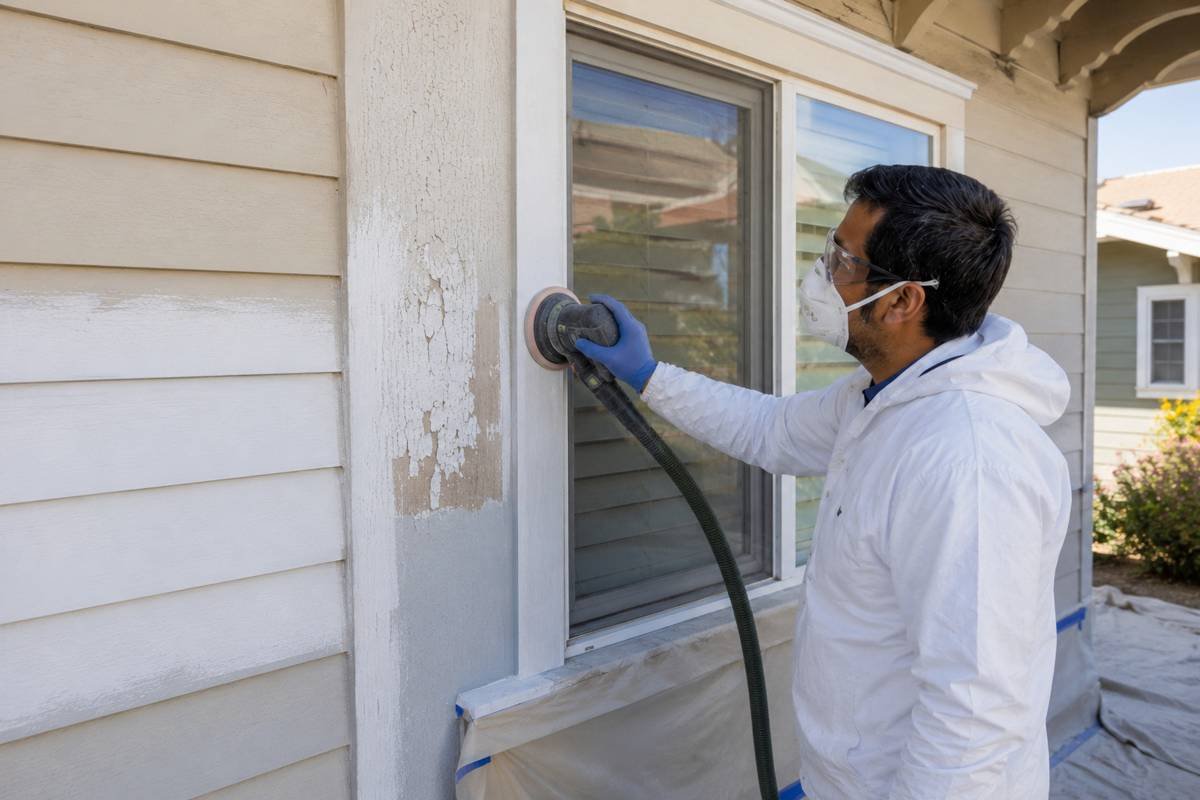
Windows, hardscape, tile roof and landscaping protected, masonry primer on repairs and bare stucco, bonding primer on chalked surfaces.
Spray and back-roll
Material pushed into the texture rather than bridged over it, then a punch walk with you.
03
Three-coat stucco versus one-coat synthetic
Identifying which one you own is the first ten minutes of the estimate.
Traditional three-coat stucco goes over lath in three passes: scratch coat, brown coat, finish coat. It is thick, heavy, and about a century of proven performance sits behind it. Most pre-war Santa Monica housing stock is three-coat. One-coat synthetic systems compress that into a single polymer-modified application over foam board, faster and lighter, common on newer infill.
They do not take paint the same way. Three-coat stucco is absorbent and alkaline and wants a masonry primer. One-coat and synthetic systems absorb less, are sometimes factory coated, and can be damaged by aggressive washing. EIFS is a separate assembly again.
Lime stucco versus portland cement stucco
Traditional lime stucco breathes. It moves vapor out of the wall, and because lime is faintly water soluble it self-heals slightly, closing its own microscopic cracks. Portland cement stucco is harder, stronger and brittle. It does not flex with the building, so when the frame moves, or the soil under a Pico Neighborhood foundation shifts, it cracks.
That drives product selection. Sealing lime stucco under a heavy impermeable film traps moisture and pushes the failure inward, which is why we route original Spanish Colonial Revival facades toward breathable limewash and silicate mineral coatings instead. Cement stucco with a crack history is the opposite case, and that is where elastomeric earns its cost.
04
Hairline cracks, elastomeric bridging and efflorescence
Applied thin to stretch a bucket, elastomeric is just expensive paint.
Hairline cracking is normal on cement stucco. It becomes a problem when it becomes a water path. Elastomeric stays flexible and builds a film thick enough to span hairlines through the seasonal expansion cycle, but only at the manufacturer's specified mil thickness. Cracks wider than the edge of a business card get repaired first.
Efflorescence is the one homeowners misread most often. Those chalky white deposits are soluble salts carried to the surface by water moving through the wall, and they mean two things: there is a moisture path, and nothing bonds until the salts are removed and the wall is neutralized and dry. Paint over efflorescence peels in sheets, usually inside a season.
Why coastal stucco repaints come around faster
Santa Monica sits on the open bay and the coating conditions are specific. The marine layer locals call May Gray and June Gloom keeps exteriors damp for hours each morning through late spring, feeding mildew and holding salt film against the wall. Then roughly 310 days of sunshine a year drive UV chalking on the same elevations. Damp, then hard sun, on repeat.
Salt-laden air accelerates all of it. West and southwest walls facing Santa Monica Bay routinely fail years ahead of the street side of the same house, so we price by elevation. Within a few blocks of the sand, our coastal and marine exterior repaint program covers the salt washdown, rust bleed and direct-to-metal work a standard spec leaves out. Where stucco meets a chimney chase or block wall, painted and coated masonry needs its own breathability decision.

05
Older stucco and the Third Street Neighborhood Historic District
Santa Monica designated the Third Street Neighborhood Historic District on July 1, 1990, its first.
It runs between Ocean Park Boulevard and Hill Street across Second, Third and Beach streets, with 38 contributing buildings from 1875 to 1930, including 27 bungalows built 1903 to 1915 and Spanish Colonial Revival bungalow courts from the mid-1920s to the early 1930s. Those courts are the classic original-stucco stock in this city.
Work on contributing properties involves the Landmarks Commission. Our historic home restoration painting crews handle the sample panels and breathable specifications those buildings need, and anything built before 1978 falls under the EPA Renovation, Repair and Painting rule, so lead-safe containment is scope, not an upsell.
Why Santa Monica homeowners choose us
We are fully licensed, insured and bonded, and send a certificate of insurance before we mobilize. Lead painters are RRP certified for pre-1978 housing. We put the repair scope in writing before the coating scope, because most stucco failures are repair problems wearing a paint problem's clothes, and one crew stays on the job from start to finish.
What shapes the estimate
Linear feet of crack repair, a second story, elastomeric instead of acrylic, hillside access, lead-safe containment on pre-1978 housing, and decorative texture matching.
06
Frequently asked questions about stucco painting
How often should stucco be repainted in Santa Monica?
Inland, a good stucco repaint holds 8 to 12 years. Within a few blocks of the bay, plan on 5 to 8, and expect the ocean-facing elevation to need attention first.
Do I need elastomeric, or is regular exterior paint enough?
Elastomeric earns its cost on cement stucco with a documented hairline cracking pattern. On sound stucco with no crack history, a quality 100% acrylic latex breathes better and costs less.
Can you match my existing stucco texture?
Yes. Smooth trowel, sand float, lace and dash are all matchable. We build a sample area and let you look at it in daylight first.
What is the white powder on my stucco wall?
Efflorescence, salt deposits carried out by moisture moving through the wall. It signals a water path, and it must be removed and the surface neutralized before any coating goes on.
Will painting stucco stop it from cracking?
No. Paint is not structural. Repair the cracks, address what is moving, then coat. Elastomeric bridges existing hairlines. It does not stop a wall from moving.
How long does a typical stucco repaint take?
A single-story home with light repair usually runs 4 to 6 working days. Two stories with significant crack repair and cure time can run 2 to 3 weeks.
Do you work with historic district or HOA colour approvals?
Yes. We prepare sample panels and submittal documents for Landmarks Commission review, HOA committees, and design review in neighbouring cities.
07
Related services and service areas
We cover the whole city, plus the neighbouring Westside and South Bay markets. In Sunset Park, Mid-City and Ocean Park that means mid-century cement stucco, bungalow courts and garden walls; bluff exposure and post-construction coating in Pacific Palisades; elastomeric and marine-grade systems in Malibu; 1920s lime and cement stucco with art jury submittals in Palos Verdes Estates; and canyon lots with fire-zone maintenance in Brentwood.
- Exterior House Painting
- Limewash & Mineral Coatings
- Marine & Coastal Exterior Repaint
- Brick & Masonry Painting
- Deck & Fence Staining
- Commercial Painting Contractors
Every painting service we offer.
Service areas
The full coverage map sits on our service areas page.
Get a free stucco painting estimate in Santa Monica
Send the address and we will walk the property, map the cracks, and give you a line-item scope separating repair from coating.
- Free written estimate including crack repair
- Texture matched by hand
- Licensed, insured and bonded