
Beautiful exterior painting and excellent workmanship from beginning to end.
Limewash and Mineral Coatings in Santa Monica, CA for Walls That Breathe and Age Well
Santa Monica Expert Painting is the Westside's trusted expert in limewash and mineral coatings, specializing in slaked lime finishes, potassium silicate mineral paint, and breathable systems for original stucco and brick. We offer substrate testing and sample board approval, with masonry preparation and mineral priming. Fully licensed, insured and bonded.
From dampening a wall to the right moisture content before the first coat goes on to a finished mineral system across a two-story elevation, our team handles every detail. Serving Santa Monica along with Bel Air, Pacific Palisades and Palos Verdes Estates, we schedule around the marine layer and put sample boards in front of you before a full wall is touched.
- Free on-site assessment
- Vapour open, so walls can dry
- Sample panels before commitment
- Licensed, insured and bonded
Reviews
What clients say about our mineral finishes
We hired the team to paint several units in our rental property. The walls, doors, and trim were finished neatly, and each space looked fresh and ready for new tenants. The results made a noticeable difference.
Our commercial storefront needed an update, and Santa Monica Expert Painting delivered exactly what we wanted. The new color scheme looks clean and professional, giving the building a much stronger street presence.
The ceiling painting came out smooth and even. The room feels much cleaner and brighter now.
We had peeling paint and minor surface damage on the outside of our home. The team prepared the problem areas carefully before applying the new paint. The finished exterior looks smooth, durable, and professionally restored.
Great work on our doors, baseboards, and interior trim. Every line looks crisp and precise.
Santa Monica Expert Painting transformed our older home with fresh interior and exterior paint. The preparation work was thorough, the color coverage was consistent, and the finished surfaces look outstanding. The entire property now feels well maintained and updated.
Santa Monica Expert Painting did a beautiful job repainting the interior of our home. The rooms look brighter, cleaner, and completely refreshed.
01
What we apply
Lime and mineral finishes are a small, specific category. We test what is already on your walls and tell you whether limewash is the right answer or the wrong one.
Traditional limewash
Slaked lime thinned with water, tinted with mineral pigments, brushed on in two to five thin coats over bare or previously limewashed masonry, stucco, brick and stone.
Potassium silicate mineral paint
A silicate binder that reacts with mineral substrates rather than sitting on them. It keeps most of limewash's vapor permeability with far better resistance to wind-driven rain, and holds colour more evenly.
Limewash on brick, block and stone
Chimneys, porch piers, garden walls and full brick elevations. Lime softens hard-fired brick without sealing it.
Mineral coatings on original lime stucco
Pre-1930 Santa Monica stucco is often lime-based and faintly water soluble, which is why it self-heals slightly and why a hard modern film ruins it.
Interior lime finishes and sample boards
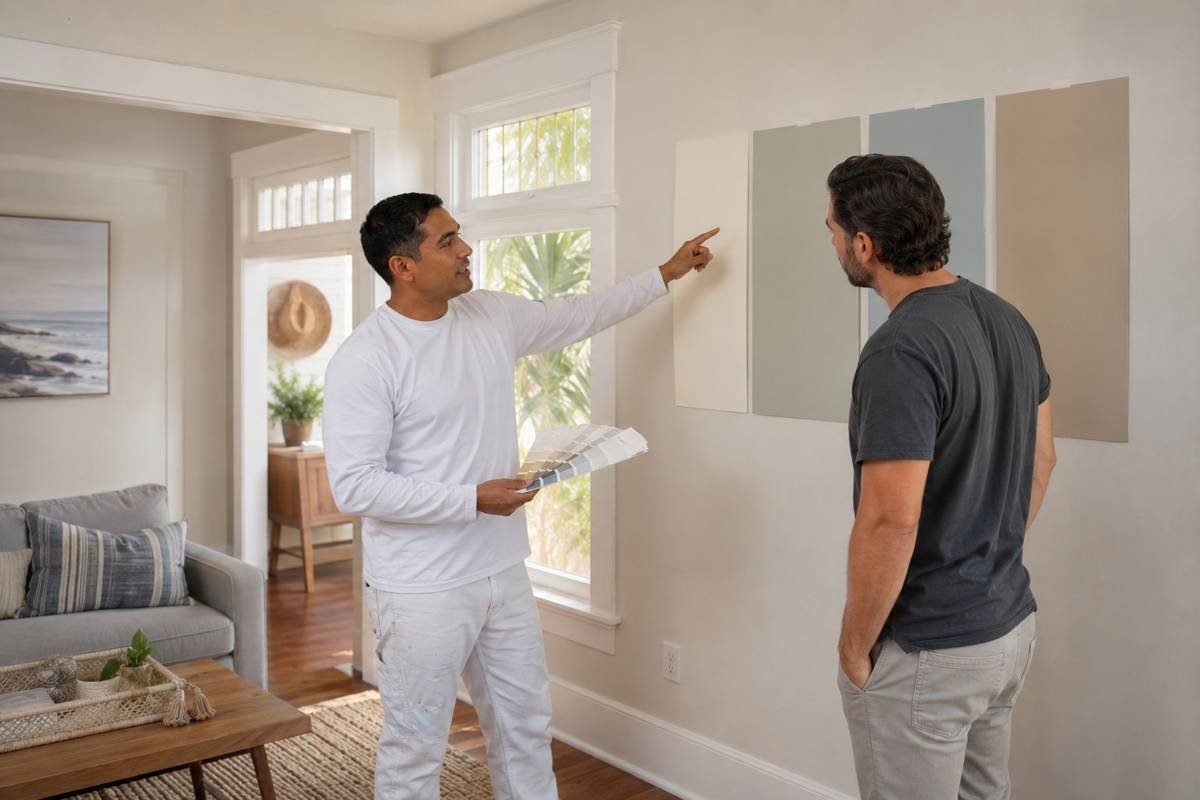
Indoors there is no weather to age the wall, so depth is built deliberately in the application. Every project starts with boards made from your substrate, pigment and coat count, viewed on site in daylight.
| System | Binder | Best substrates | Trade-off |
|---|---|---|---|
| Traditional limewash | Slaked lime, mineral pigment | Bare lime stucco, brick, stone | Fully breathable, softest against rain |
| Pozzolan or linseed-modified limewash | Lime plus additive | Exposed elevations, parapets, sills | More water resistant, less breathable |
| Potassium silicate mineral paint | Potassium silicate | Mineral stucco, concrete, masonry | High permeability with real rain resistance |
| Silicate mineral primer | Potassium silicate | Sound acrylic-coated stucco | Bridges a film so a mineral topcoat can bond |
| Mineral pigment tint | Iron and earth oxides | All of the above | Lightfast, limited to earth-derived colour |
Lime and silicate finishes have no sheen ladder. They land between chalky matte and soft eggshell depending on coat count, dilution and how much the substrate pulls. Nobody makes a high-gloss limewash.
02
Our process, step by step
Eight stages, with mix records left behind for future refresh coats.
Substrate identification
We establish what is on the wall: bare lime stucco, portland cement stucco, brick, or an acrylic film from a repaint in 2005. A water-drop absorption test settles it.
Testing and repair
Cracks, spalls and efflorescence are addressed with compatible lime-based patching, never a hard cement mix on a soft wall.
Cleaning
Low-pressure washing, hand brushing and biological growth treatment. No high-pressure blasting.
Sample boards
Two to four boards on your substrate, coat counts and dilutions recorded, approved on site in daylight.
Dampening
The wall is misted to a controlled damp before the first coat.
Application
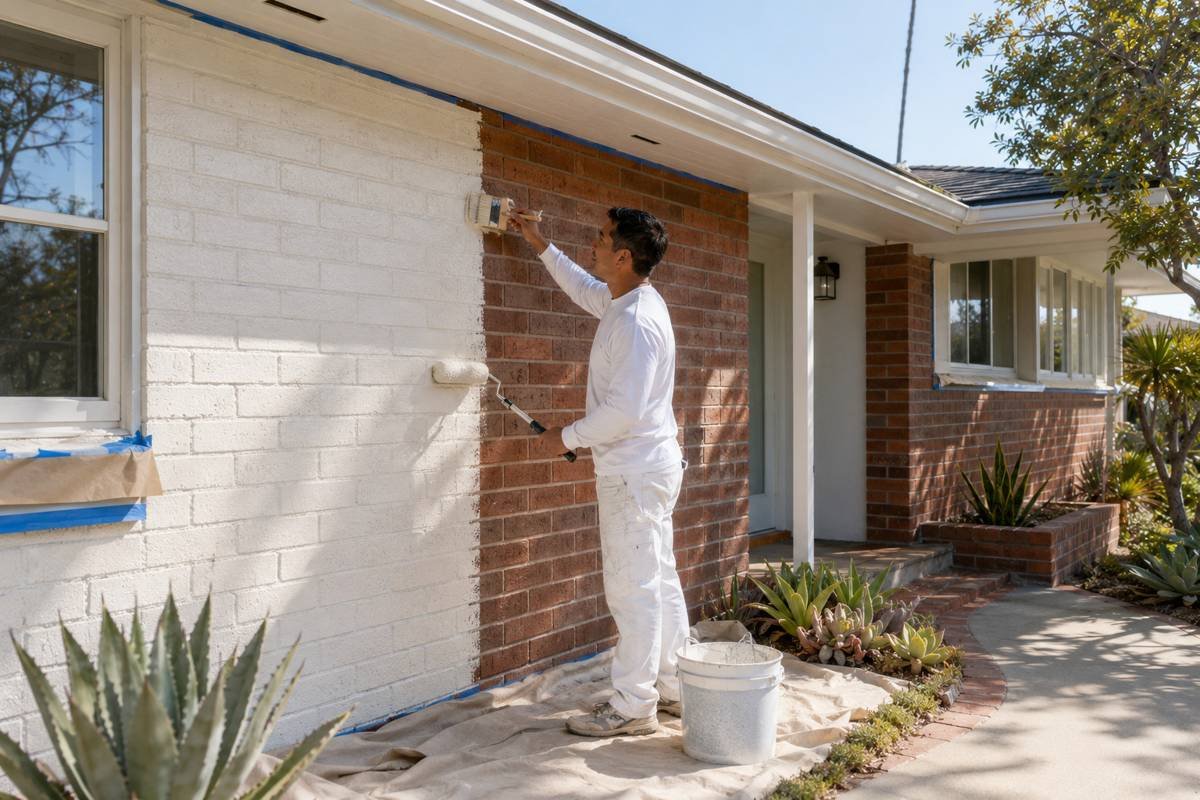
Brushed with a wide block brush in a random cross-hatch, each coat set before the next.
Carbonation
Coats are kept damp for a day or two in dry weather so the lime carbonates instead of drying out.
Walkthrough
Final inspection in the same daylight, with mix records left for future refresh coats.
03
How limewash cures, and why it glows
Limewash is not paint in the way acrylic is paint.
It is slaked lime, calcium hydroxide, suspended in water, and it never dries into a film. It cures by carbonation: calcium hydroxide reacts with atmospheric carbon dioxide and converts into calcium carbonate, which is limestone. The wall ends up chemically the same material as the rock the lime came from.
That reaction is also why the finish looks the way it does. Carbonation leaves microscopic calcite crystals, and calcite double-refracts light, splitting one ray into two paths. Light entering the surface scatters instead of bouncing straight back, so the wall reads as luminous and changes through the day. No acrylic reproduces it, because the effect is crystalline rather than pigmentary. The property that makes limewash beautiful also makes it inconsistent by nature.
Absorption, dampening and why the substrate decides everything
Limewash is absorbed into masonry. It does not adhere to it. There is no bond layer holding a film onto the surface, so the finish is only as sound as the material it soaked into.
The wall has to be damp when the first coat lands. Bone dry, it pulls water out of the wash instantly, the lime never carbonates properly, and the surface powders off on your hand. Soaking wet, there is nowhere for the wash to go, so it sits on top instead of penetrating and cures weak. The window between the two is narrow, and on a Santa Monica afternoon with 310 days of sunshine a year it can close in twenty minutes. We mist ahead of the brush, start on the shade side, and work early while the morning damp off the bay still helps.
04
Breathability, driven rain, and when silicate is the better call
Vapor permeability is not a luxury on an old wall. It is what keeps the wall working.
A lime or brick wall built before the 1930s manages moisture by letting it pass through and evaporate. Put an acrylic film over it and water still gets in at a crack, a sill or a failed flashing, but now it cannot get out. It moves sideways, blisters the film off, carries salts to the surface as efflorescence, and rots the wood it reaches.
Limewash is superb at this and poor at shedding driven rain. On an elevation taking wind off the Santa Monica Bay, unmodified limewash erodes. It can be modified with pozzolans, a small cement addition or linseed oil, and each costs breathability in direct proportion to the water resistance it buys. Potassium silicate mineral paint is usually the better answer on weather elevations: the binder reacts chemically with the mineral substrate, permeability stays high, rain resistance is far better than lime alone. Many of our projects are a hybrid, limewash on protected walls and courtyards, silicate where the weather lands.
05
Where limewash belongs and where it does not
Most companies will happily brush limewash onto anything. Fewer will tell you the wall is wrong for it.
It belongs on bare or previously limewashed lime stucco, brick, stone and block, and on lime plaster indoors. It suits 1920s and 1930s Spanish Colonial Revival stucco better than anything else on the market.
It does not belong over acrylic-coated stucco. There is nothing for it to soak into, so it powders and sheds. The options there are strip the film, or use a silicate mineral primer designed to bridge a coated surface so a mineral topcoat can bond. Both cost money, and we say which applies before you set a budget. It is also a poor choice on a wall with unresolved water intrusion, on uncured portland cement stucco, and anywhere the client wants a flat, even, repeatable colour.
Variation is the finish, not a defect in it. Limewash moves in tone across a wall, sits lighter on a high spot and deeper in a trowel mark, and softens into patina. If you want uniformity, we will quote an acrylic or silicate system instead.
Maintenance and refresh coats
Exterior limewash typically wants a refresh every five to seven years on exposed elevations, longer on sheltered ones. A refresh is one thinned coat over a clean wall, not a strip and restart, which is why lifetime cost compares well against a repaint cycle. We keep your pigment ratio and coat count on record so the next coat matches. Silicate systems run longer between recoats.
What shapes the estimate
Whether an acrylic film has to be stripped or primed, coat count, substrate absorbency, masonry repair and elevation height. Bare brick sits at the bottom of the range. A three-story stucco elevation with a film to remove and five coats to build sits at the top.
06
Frequently asked questions about lime and mineral finishes
Can you limewash over painted stucco?
Not directly. Limewash needs to be absorbed, and an acrylic film gives it nothing to soak into, so it powders off. The wall has to be stripped or given a silicate mineral primer made for previously painted surfaces.
How long does limewash last outside?
Ten years or more on a sheltered elevation. On a wall taking wind-driven rain off the bay, expect a refresh every five to seven years. It erodes rather than peels, so maintenance is a single coat.
What is the difference between limewash and mineral paint?
Limewash is slaked lime curing by carbonation, absorbed into the wall. Potassium silicate paint uses a binder that reacts with the substrate, holds colour more evenly and shrugs off rain better while staying vapor permeable.
Why does my limewash look blotchy?
Because it is supposed to vary, and because the substrate is probably uneven in absorbency. Genuine blotching from poor dampening or too few coats is a different problem, and additional coats fix it.
Is limewash waterproof?
No, and it is not meant to be. It lets moisture pass and evaporate. Adding pozzolans, cement or linseed oil raises water resistance and lowers permeability at the same rate.
Can limewash be colour matched?
To a range, not to a chip. Pigments must be lime-stable earth and iron oxides, so the palette runs to whites, ochres, umbers, greys, terracottas and muted greens. Bright organic colours are not available in a true lime finish.
Do you make sample boards?
Always, on your own substrate, with coat count and dilution recorded. Limewash changes as it carbonates, so boards are reviewed cured, not wet.
07
Related services and where we apply lime finishes
We cover Santa Monica ZIP codes 90401 through 90405, from the bungalow courts off Second Street to the Spanish stucco homes North of Montana.
- Historic Home Restoration Painting
- Venetian Plaster & Specialty Finishes
- Brick & Masonry Painting
- Stucco Painting
- Interior House Painting
- Wallpaper Removal & Repainting
Every painting service we offer.
Service areas
Beyond the city, Palos Verdes Estates means 1920s lime stucco under an art jury that approves exterior colour before a brush moves, Bel Air brings hillside elevations and designer colour approvals, and Pacific Palisades covers rebuild work where original materials matter. The cities we serve page has the full map.
Get your limewash or mineral coating estimate
We test the wall, say plainly whether lime, silicate or a conventional coating suits it, and put sample boards in front of you before you spend anything.
- Free written estimate including sample panels
- Substrate tested for suitability
- Licensed, insured and bonded