
Excellent painting and careful preparation. Our house looks amazing!
Garage Floor Epoxy Coating in Santa Monica, CA That Stays Bonded
Santa Monica Expert Painting is the Santa Monica Bay region's trusted expert in resinous floor coatings, specializing in garage floor epoxy, full-flake broadcast systems, and polyaspartic topcoats. We offer diamond-ground concrete preparation, metallic epoxy finishes, and moisture vapor testing with crack and spall repair before any resin is mixed. Fully licensed, insured and bonded.
From a resin-to-hardener ratio weighed to the manufacturer's exact specification to a full-scope two-car buildout with cove base and a clear urethane topcoat, our team handles every detail. Serving Santa Monica and nearby Brentwood, Beverly Hills and Manhattan Beach, we test the slab for moisture before we quote.
- Free estimate, slab tested first
- Ground, never acid-etched
- Polyaspartic topcoat for hot tyres
- Licensed, insured and bonded
Reviews
What clients say about our floor coatings
We hired Santa Monica Expert Painting to repaint our living room, kitchen, and hallway. The lines around the trim and ceilings came out incredibly clean, and the new colors transformed the entire space. Everything was left neat when the work was finished.
Our home’s exterior looks brand new again. The finish is smooth, even, and professionally done.
The team painted our kitchen cabinets, and we couldn’t believe the difference. The doors and drawers have a smooth, factory-like finish, and the new color made our entire kitchen feel more modern.
Friendly service, beautiful results, and great attention to detail.
Santa Monica Expert Painting repaired several damaged areas of drywall before repainting our bedroom. The repaired sections blend perfectly with the surrounding walls, and the finished room looks clean and polished.
The exterior paint had faded badly from years of sun exposure. After the project was completed, our home had stronger curb appeal and a fresh, updated appearance. The trim work looks especially sharp.
Our bathroom painting project came out beautifully. Clean edges and a flawless finish!
01
Garage floor coating services
We test the slab for moisture before we quote, because on this coast that test decides whether a coating lasts a decade or lifts in a year.
Full-flake broadcast systems
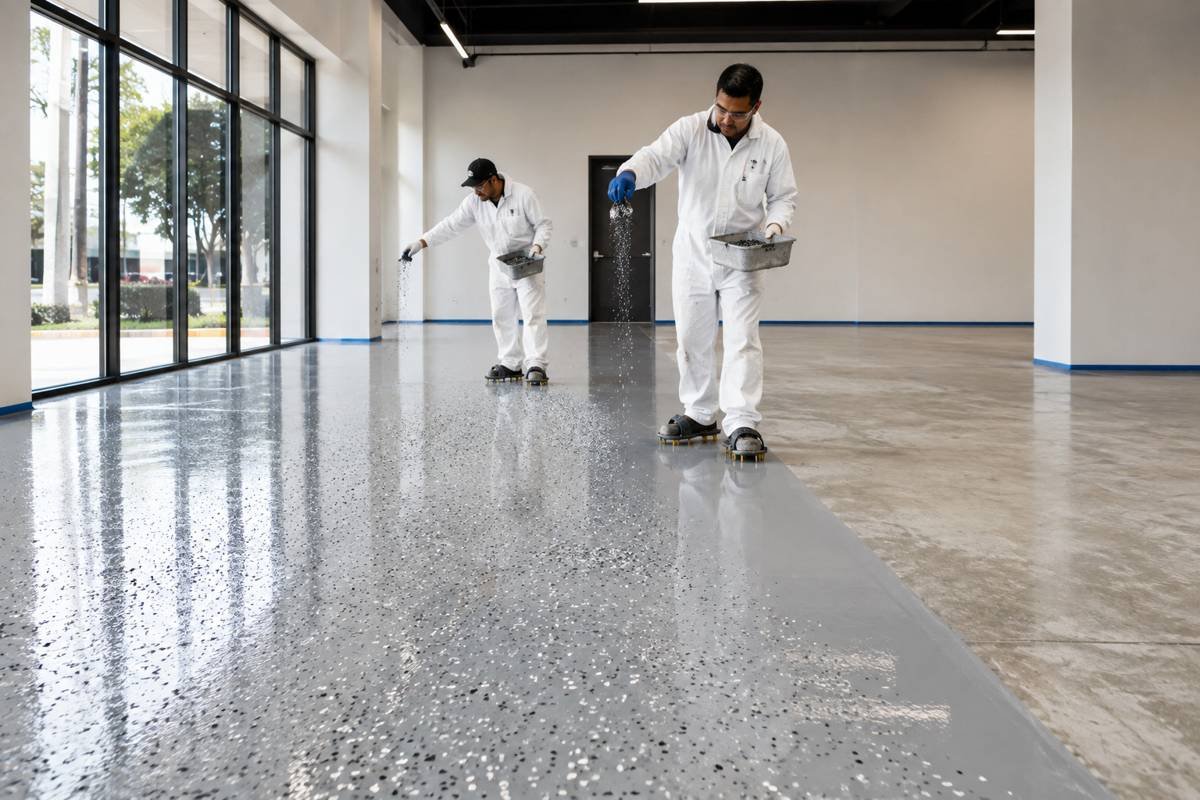
Coloured vinyl flake is broadcast to rejection into wet epoxy, the excess scraped back, then sealed with a clear topcoat. It hides dust, hairline cracks and future patches, and gives real slip texture. Most Santa Monica homeowners want this one.
Solid colour epoxy
A pigmented two-coat build in one colour. Clean, economical, and the least forgiving finish there is, because every trowel mark reads through. Best on newer, flat slabs.
Metallic epoxy
Reflective pigments are moved through clear resin to create depth and marbling. It is decorative, sensitive to installer technique and lighting, and belongs in a finished garage rather than a working shop.
Crack, spall and joint repair
Cracks get chased open and filled with rigid polyurea or epoxy mortar. Spalled edges at the door threshold, where water has sat for twenty years, get rebuilt. Control joints are honored or filled by system.
Cove base and trim details
A coved transition where the slab meets the wall makes the floor washable and keeps water from behind the coating. On subterranean garages it is close to mandatory.
02
The chemistry, and why it matters to your floor
Epoxy is not paint. It is a two-part system, resin and hardener, mixed to a precise ratio.
Once combined they react and cure exothermically, generating their own heat. That is why mixing discipline matters. A batch mixed by eye stays soft or cures unevenly, and no topcoat fixes it.
Cured epoxy holds concrete three ways at once. It grips mechanically, keying into the profile of a roughened surface. It holds by proximity, through attraction where the resin sits tight against the substrate. And it bonds ionically with the mineral chemistry of the slab. All three need a clean, open, properly profiled surface. A sealed or polished slab gives the resin nothing to hold.
| System | Best use | Estimated service life |
|---|---|---|
| Full-flake epoxy with urethane topcoat | Everyday garages | 10 to 15 years |
| Solid colour epoxy | Newer flat slabs, budget projects | 5 to 10 years |
| Metallic epoxy | Finished garages | 10 to 15 years |
| Polyaspartic topcoat | Fast return to service | 10 to 20 years |
| Polyurethane topcoat | Abrasion and chemical resistance | 10 to 20 years |
Polyaspartic and polyurethane are topcoats, not replacements for the epoxy body coat. Epoxy is the workhorse underneath: strong, thick-building, adhesive. It is not UV stable on its own and ambers where sunlight hits it, which matters on any garage whose door stands open through a Santa Monica afternoon. A clear polyaspartic or urethane solves that, adds abrasion and chemical resistance, and takes the scuffing.
03
Preparation is the job
Etched floors are the ones we come back to strip.
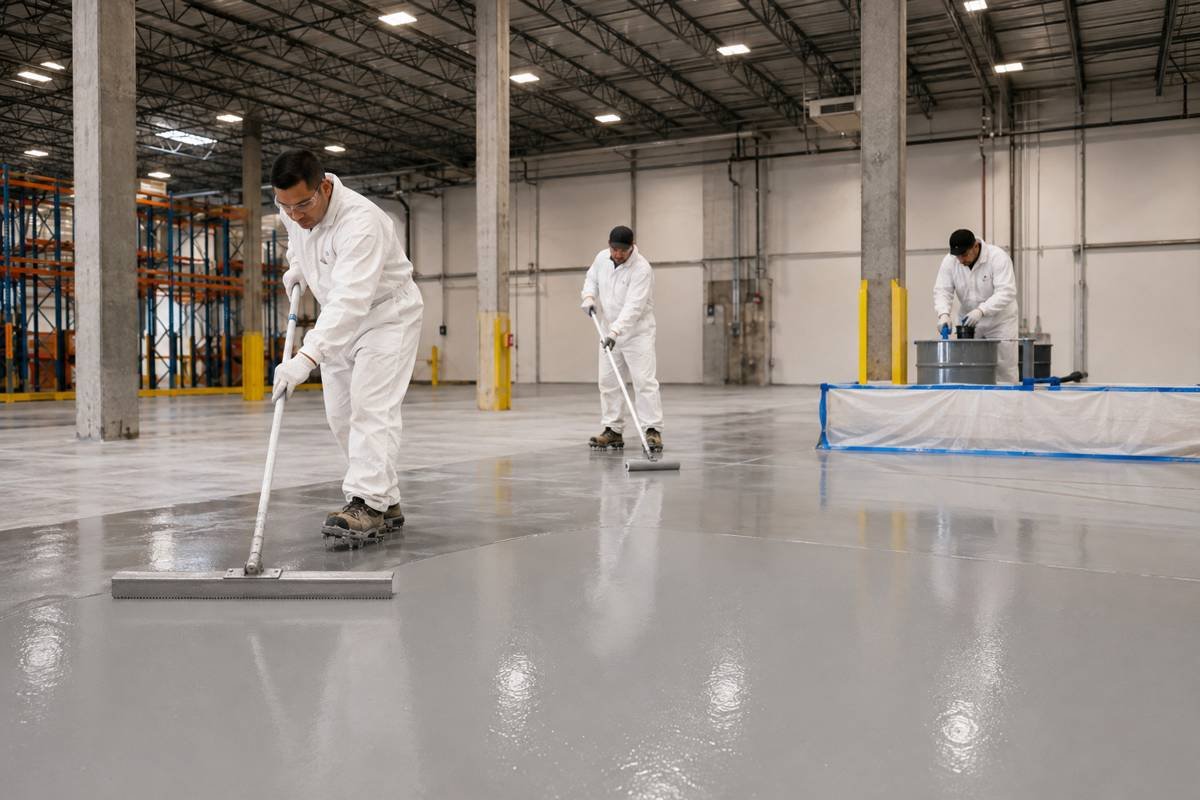
Diamond grinding is our standard. A weighted grinder with diamond tooling cuts the surface open to a measurable profile, removes old sealers and contamination, and leaves the mineral face exposed. Shot blasting does the same faster on large floors by firing steel shot at the slab, the right choice on a subterranean deck of several thousand square feet.
Acid etching is what a weekend kit tells you to do. Muriatic acid roughens the top of the surface, but it does not remove sealers or oil, it leaves residue needing neutralizing and rinsing, and it cannot deliver a consistent profile. That gap between a ground floor and an etched one is most of the reason a big-box kit peels within two years, along with thin film build and no real topcoat.
Then there is moisture
Concrete is a sponge with a hard face. Water vapor moves up through a slab from the ground beneath, and when it meets an impermeable coating it collects, builds pressure, and pushes the film off in sheets. We test for it with calcium chloride vapor emission tests or relative humidity probes set into drilled holes. Slabs near Ocean Avenue, in Ocean Park, and across the low ground toward the Santa Monica Pier sit close to a coastal water table, and many were poured before vapor barriers were standard. A slab that fails is not a lost cause. It needs a moisture-mitigating primer rated for that vapor pressure before the epoxy goes down.
04
Our process, step by step
Nine stages, with the moisture result and the system recommendation both in writing.
Site visit
We measure, check drainage and slope, and photograph existing cracks and stains.
Moisture testing
Results in writing, with the system recommendation that follows from them.
Repair
Cracks routed and filled, spalls rebuilt, oil-contaminated areas degreased or cut out.
Diamond grinding or shot blasting
Wall to wall, edges included, with HEPA vacuum extraction.
Priming
Standard or moisture-mitigating primer, depending on the test.
Body coat and broadcast
Epoxy at spec thickness, flake broadcast to rejection where the system calls for it.
Scrape and vacuum
Loose flake removed, the surface knocked down smooth.
Topcoat
One or two coats of polyaspartic or polyurethane, with anti-slip additive where wanted.
Cure and handover
We walk the floor with you and leave the maintenance sheet.
05
Cure times, hot tire pickup and garage types
Epoxy cures by chemical reaction, not by drying, so temperature drives the clock.
Coastal Santa Monica runs five to ten degrees cooler than inland Los Angeles, and a garage that never gets above 60 degrees in a June Gloom week cures slower than the data sheet suggests. Foot traffic is typically 12 to 24 hours after the final coat, light furniture and storage 24 to 48 hours, vehicle traffic 5 to 7 days for epoxy systems, and full chemical cure up to 7 days. Polyaspartic topcoats compress that schedule, which suits a homeowner who needs the car back this weekend.
Hot tire pickup, and why kits fail
Tires get hot on Interstate 10 and stay hot when you park. A hot tire softens, plasticizes the coating under it, and when the rubber cools it grips and contracts. If the bond to the concrete is weaker than the bond to the tire, the coating lifts in a circle the size of your contact patch. That is hot tire pickup, the classic failure of thin, acid-etched, single-part floor paint. Real epoxy at proper film build over a ground profile resists it, because the bond to the slab is stronger than anything a tire can do. A polyaspartic topcoat ends the conversation entirely. The same logic governs every coating we install, including the ocean-facing elevations we repaint on coastal homes.
Garage types we coat
Santa Monica's housing stock is unusual. Across 47,438 households, 72.9% renter-occupied, garages range from detached single-car structures behind 1920s bungalows in Ocean Park to subterranean parking under condo buildings off Wilshire Boulevard. Single-car detached garages are usually one-day floors, often on the oldest and roughest slabs in the city. Two-car attached garages are the standard project, a two-day install plus cure. Subterranean condo garages bring the hard questions: vapor pressure is higher underground, ventilation is limited, and access has to be scheduled around residents. Larger shared decks are better served by our industrial and protective coatings work, scoped and phased for commercial-scale floors.
What shapes the estimate
Square footage, slab condition, crack and spall repair, whether moisture mitigation primer is required, the system chosen, the number of topcoats, cove base, and access. A subterranean garage with a stair-only route for equipment runs higher than a driveway-level two-car.
06
Frequently asked questions about garage floor epoxy
How long does a garage floor epoxy coating take to install?
Most two-car garages are a two-day install. Add cure time before vehicles return: five to seven days for epoxy, less with a polyaspartic topcoat.
Do I have to empty the garage?
Yes, completely. The floor is ground wall to wall, including under shelving. We can help move heavy items, and the garage stays unusable through cure.
Why can I not just use a kit from the hardware store?
Kits rely on acid etching rather than grinding, apply a thin film, and skip a real topcoat. Together those produce hot tire pickup and peeling, often within two years.
What is moisture vapor testing and do I need it?
It measures how much water vapor is moving up through your slab. On older Santa Monica slabs near the water table we treat it as non-negotiable. A failing result means a mitigation primer, not a cancelled project.
Can you coat a cracked or spalled floor?
Yes. Cracks are routed and filled and spalled edges rebuilt before coating. Actively moving structural cracks are a different conversation, and we will say so.
Flake, solid colour or metallic?
Flake hides imperfections and adds texture, which makes it the most common residential choice. Solid colour is cleanest but shows everything. Metallic is decorative, best in a finished space.
Will the floor be slippery when wet?
Flake adds texture on its own. Where a floor gets wet often, we add an anti-slip aggregate to the topcoat.
How do I maintain it?
Dust mop, rinse, and clean spills promptly. Avoid dragging steel-edged tools and citrus-solvent degreasers.
Do you coat commercial and shared garages?
Yes, though larger decks are scoped through our commercial coatings work rather than as a residential install.
07
Related services and service areas
We coat garage floors throughout Santa Monica, from North of Montana through Mid-City, the Pico Neighborhood, Sunset Park, Ocean Park and Main Street, across ZIP codes 90401 to 90405.
- Deck & Fence Staining
- Exterior House Painting
- Brick & Masonry Painting
- Interior House Painting
- Industrial & Protective Coatings
- Marine & Coastal Exterior Repaint
Every painting service we offer.
Service areas
Beyond the city we work in Brentwood, Beverly Hills and Manhattan Beach. Our service areas across the Westside and South Bay list every city we cover.
Get a free garage floor epoxy estimate
We measure the slab, test it for moisture, and give you a written scope naming the system, film build and cure schedule.
- Free written estimate including moisture testing
- Diamond ground, never acid etched
- Licensed, insured and bonded