
We hired Santa Monica Expert Painting to repaint our living room, kitchen, and hallway. The lines around the trim and ceilings came out incredibly clean, and the new colors transformed the entire space. Everything was left neat when the work was finished.
Apartment Complex Painting in Santa Monica, CA
Santa Monica Expert Painting is Los Angeles County's commercial multifamily painting contractor, working with property managers, apartment owners and asset managers on building exterior repaints, corridor and common-area interiors, and balcony, railing and stair-tower coatings. We handle 12-unit courtyard buildings through 300-plus-unit mid-rise portfolios, painted while fully occupied and phased building by building. Fully licensed, insured and bonded.
From access takeoffs and swing stage rigging plans to punch walks and labeled attic stock at closeout, our team handles the parts of a commercial job that decide whether it finishes on schedule.
Serving Santa Monica and the surrounding Los Angeles County market, we hold the GC's schedule, work nights and weekends where the property requires it, and turn the work over ready for punch and inspection.
- Phased so residents keep access
- Line-item bid with unit prices
- One site contact throughout
- Licensed, insured and bonded
Reviews
What owners and managers say about our multifamily work
Our home’s exterior looks brand new again. The finish is smooth, even, and professionally done.
The team painted our kitchen cabinets, and we couldn’t believe the difference. The doors and drawers have a smooth, factory-like finish, and the new color made our entire kitchen feel more modern.
Friendly service, beautiful results, and great attention to detail.
Santa Monica Expert Painting repaired several damaged areas of drywall before repainting our bedroom. The repaired sections blend perfectly with the surrounding walls, and the finished room looks clean and polished.
The exterior paint had faded badly from years of sun exposure. After the project was completed, our home had stronger curb appeal and a fresh, updated appearance. The trim work looks especially sharp.
Our bathroom painting project came out beautifully. Clean edges and a flawless finish!
We needed our office repainted without creating a major disruption for employees. Santa Monica Expert Painting handled the project efficiently and gave the entire workspace a brighter, more professional appearance.
01
Scope and project size
Multifamily repaints here run from 12 units to 300 and above, across buildings of two to eight stories, with 20,000 to 400,000 square feet of coated surface once elevations, soffits, corridors, stair towers and railings are measured.
A single 24-unit courtyard building off Ocean Park Boulevard is a three to four week job. A 280-unit garden-style property spread over six buildings is a staged program of ten to sixteen weeks with a separate mobilization per building.
Scope splits into four measurable buckets. Exterior field and trim, which is stucco, siding, fascia, soffit and door frames. Metal, which is balcony rail, guardrail, stair pan, stringer, gate and utility door. Common-area interior, which is corridors, lobbies, laundry rooms, mail alcoves and stair towers. And carpentry allowances for dry rot, fascia replacement and sealant, carried as unit prices so the owner is not paying a lump sum for damage nobody has seen yet.
| Buyer | Typical property |
|---|---|
| Owners and operators | Garden-style and courtyard apartment buildings, 12 to 60 units |
| Property managers | Mid-rise and podium properties of 60 to 300-plus units |
| Asset managers | Multifamily assets being repositioned before or after a hold period |
| Regional and institutional managers | Multi-property portfolios across the Westside |
| General contractors | Multifamily renovation or repositioning packages |
| Receivers, lenders and asset servicers | Buildings being prepared for sale or refinance |
02
Access: garden-style versus mid-rise
Access drives the number more than paint does.
Garden-style walk-ups
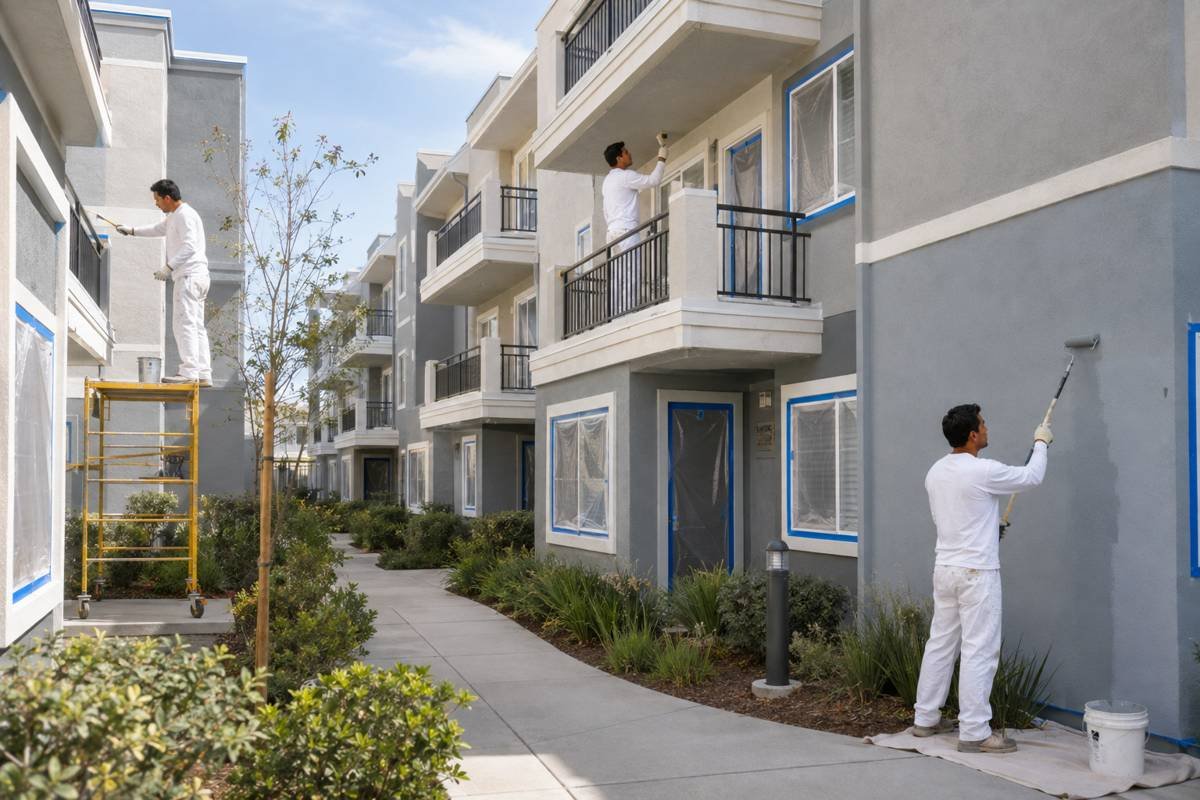
On two and three storeys, most elevations are reachable from ladders and rolling scaffold, with a towable boom lift brought in for high gable ends, tall stair towers and anything over a landscaped setback. Ladder work is cheap and slow. It also means crews are moving constantly through resident areas, so the schedule has to keep pace with the notice already posted.
Mid-rise, four to eight storeys
Swing stage suspended from roof outriggers or parapet clamps gives a controlled drop on long uninterrupted elevations and is the fastest way to move a high-build coating across a tall stucco face. It also requires an engineered rigging plan, roof anchor review, tie-back points, controlled-access zones at grade and a daily pre-use inspection. Where the roof will not carry a stage or the elevation is broken by balconies, a 60 to 80 foot articulating boom lift works off the drive aisle instead, which is why parking phasing gets planned before the first ladder goes up.
Most Santa Monica properties end up mixed. Street elevations often have no lay-down room at all because the building sits close to the sidewalk on Lincoln Boulevard or Pico Boulevard, so those faces get swing stage or a night-shift lift window while courtyard elevations run on ladders during the day.
03
Balcony, railing and stair-tower coatings
Metal fails first on this coast and it fails visibly.
Balcony guardrails, stair stringers, pan treads and handrails carry chloride from the marine air, and once rust starts under an old alkyd film it bleeds down the stucco and stains the elevation below.
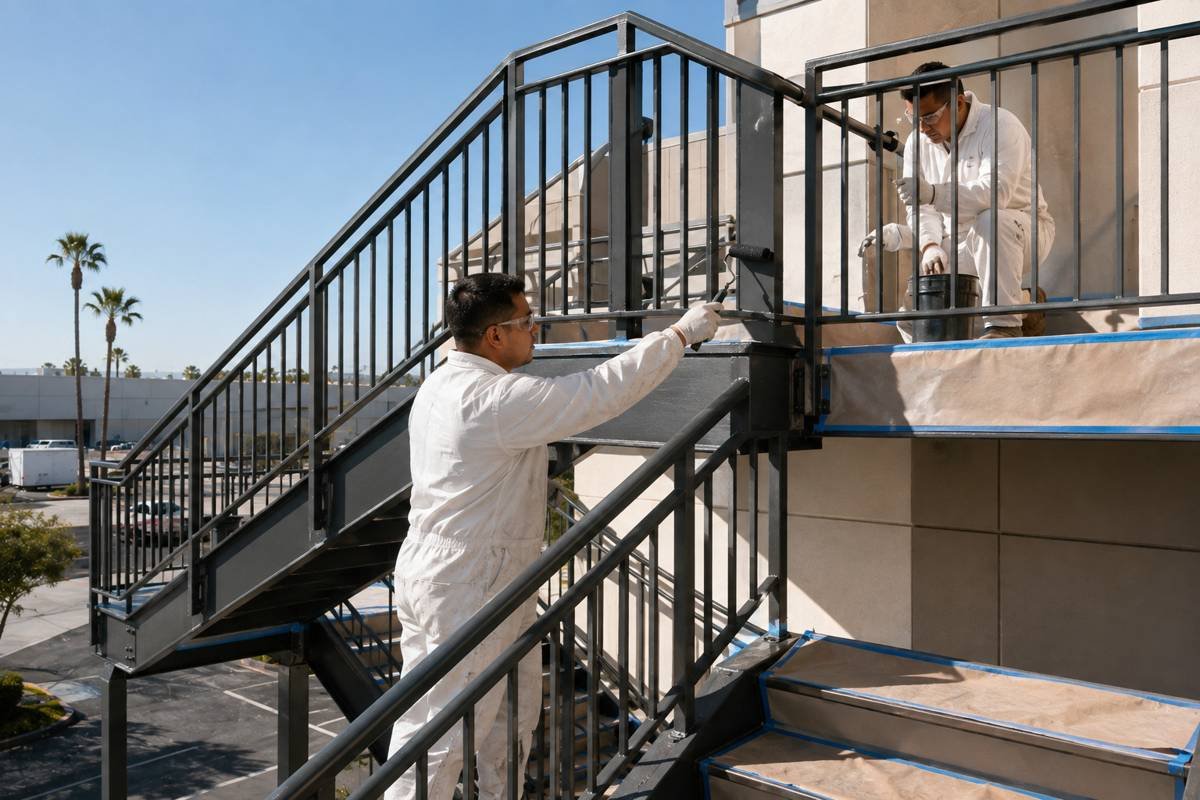
Ferrous metal is prepped to a bright or near-bright profile with mechanical tools or targeted blasting, spot primed with a zinc-rich primer where corrosion has reached bare steel, then finished with a direct-to-metal acrylic or urethane-modified DTM topcoat. Zinc-rich primer works sacrificially, protecting the steel at scratches and pinholes rather than only sealing it. Galvanized rail and aluminium get a different path, a bonding or etch primer under DTM, because a standard alkyd will saponify on galvanizing.
Stair towers get treated as one assembly. Treads and landings take a slip-resistant deck or traffic coating with broadcast aggregate, risers and stringers take DTM, and the underside of the run gets coated at the same time because nobody wants a second mobilization to reach it. Balcony walking decks are inspected before pricing; a deck with a failed waterproof membrane is a waterproofing scope, not a paint scope, and we call it out rather than coating over it.
04
Stucco repair and elastomeric on coastal buildings
Most multifamily stock in 90403, 90404 and 90405 is stucco over lath.
Portland cement stucco is hard and brittle, so it cracks when the framing behind it moves, and salt-laden air off Santa Monica Bay accelerates everything that follows: chalking, efflorescence, rust bleed at metal penetrations and moisture intrusion at hairlines.
Prep sequence is fixed. Pressure wash the whole envelope, let it dry, then scrape and sand failing film, route and patch structural cracks with a polymer-modified patching mortar, fill hairlines with an elastomeric patching compound, and replace failed sealant at window perimeters, control joints and dissimilar-material transitions with a urethane or hybrid sealant rather than painting over dried-out caulk.
The coating choice follows the crack pattern. Where hairline cracking is widespread, a high-build elastomeric applied at the manufacturer's wet mil rate bridges movement and gives the longest interval before the next repaint. Where the stucco is sound, a high-build 100% acrylic over a masonry conditioner breathes better. Elastomeric is not automatically the right call, because a film that tight over a wall with trapped moisture blisters. We check moisture at suspect elevations before specifying.
Salt air shortens exterior repaint cycles here. Inland Los Angeles County stucco can run ten to twelve years between repaints. Ocean-facing elevations within a few blocks of the beach in Ocean Park and along Ocean Avenue routinely need seven to eight, and the windward face often needs attention two or three years before the leeward face does. Repainting one elevation on an off-cycle is cheaper than repainting four early.
Corridor and common-area interiors
Interior scope on an occupied complex is corridors, lobbies, elevator lobbies, stair towers, laundry rooms, mail alcoves, leasing offices, fitness rooms and the doors that open onto them. Corridors take an eggshell or satin 100% acrylic that survives washing and scuffing from move-ins. Unit entry doors and frames take waterborne alkyd or urethane-modified acrylic for a hard, washable film that blocks in a day so the corridor is not closed overnight. Ceilings take flat. Stair towers get the same wall system as corridors with DTM on the metal. Where an existing corridor scheme is being replaced rather than refreshed, we spray and back-roll behind containment on a half-width basis so one side of the corridor stays walkable at all times.
05
Phasing a fully occupied property
Nobody empties an apartment building to paint it. The phasing plan is the deliverable that makes the rest work.
We break the property into zones, usually one building, one wing or one stack at a time, and publish a rolling two-week look-ahead to the management office. Residents get written notice 72 hours before work reaches their elevation, posted at entries and delivered unit-side, with a plain description of what will happen and what they need to move. Balcony and patio clear-off requests go out with that notice, with a stated date and a follow-up for units that miss it.
Unit-side access windows are scheduled in blocks, typically 8am to 4pm on named days, so a resident knows which two days their balcony is a work zone rather than which three weeks. Anything requiring entry into a unit is scheduled separately with its own notice under the terms of the lease.
Parking is the item that generates the most complaints and the easiest one to solve. We stage lifts, material and containment so no assigned space is lost. If a boom lift has to occupy a drive aisle or a stall, that stall is used only during posted hours and released nightly, and we coordinate a temporary swap with the manager in advance rather than coning a space and letting the office absorb the calls.
Work hours respect the property's quiet hours. Pressure washing and mechanical prep run in the mid-morning to late-afternoon window. Common areas are reset, swept and reopened every evening. Nothing is left staged in a corridor or a courtyard overnight.
Credentials and compliance
We hold California Contractor License #585047 (C-33 Painting and Decorating), carry general liability and umbrella coverage, and maintain workers' compensation on every employee. Certificates of insurance naming the owner, the management company and the lender as additional insureds are issued before mobilization, with waiver of subrogation and primary and non-contributory wording where the contract requires it. Crews are RRP-certified for pre-1978 buildings, which covers a large share of the rental stock in 90401 through 90405. All architectural coatings meet South Coast AQMD Rule 1113 VOC limits. Swing stage and aerial lift operators are trained and documented, and fall protection plans are submitted with the phasing plan.
How apartment repaints are priced
Building-wide repaints are priced per contract, with measured square footage behind the number and damage carried as unit prices. Variables that move it: access method, colour change and coat count, linear feet of railing and stair metal, the volume of stucco crack repair and sealant replacement carried, dry rot found at fascia and trim, night or weekend premium hours, and how tightly the property has to be phased.
Scheduling, lead time and capacity
Full exterior repaints book four to eight weeks out. Between November and March the calendar compresses because rain windows and morning damp off the bay push start times later in the day and cost usable hours. Corridor and common-area interior packages mobilize two to three weeks after award and are unaffected by weather. We can field more than one crew on a single property to compress a multi-building schedule when a refinance or a sale date is driving it.
06
Why multifamily repaints are an operating expense here
Santa Monica is a renter city. 72.9% of its 47,438 households rent, and 27,589 rental units sat under rent control as of December 31, 2025 under the Rent Control Board's annual report.
That combination changes how a repaint gets budgeted. Where an owner cannot simply reprice a unit to cover deferred maintenance, condition has to be held on a cycle rather than fixed in a crisis. Buildings under long-term ownership on Ocean Park Boulevard, in the Pico Neighborhood, along Wilshire Boulevard and through Mid-City run repaint programs as a recurring line in the operating budget, funded annually, not as a one-off capital event that gets deferred until the stucco fails.
The coastal exposure reinforces it. Salt air off Santa Monica Bay shortens every exterior cycle in the city, and a building that skips a cycle pays for it in stucco repair and rust remediation instead of paint.
07
Frequently asked questions about apartment complex painting
How large a property can you take on?
Buildings from 12 units to 300 and above, two to eight stories, and 20,000 to 400,000 square feet of coated surface. Multi-building properties are bid and scheduled building by building.
How is an apartment complex repaint priced?
Per contract, with measured square footage behind the number and damage carried as unit prices. A measured line-item bid follows the site walk rather than a figure over the phone.
Do residents have to move out or leave during the day?
No. The work is phased so units stay occupied and accessible. Residents receive 72-hour written notice before work reaches their elevation, plus a balcony and patio clear-off request.
Will residents lose parking?
No assigned space is taken out of service. Lifts and staging are planned around the parking layout, and any stall used for a lift is limited to posted hours and released nightly.
How do you handle rusting balcony railings?
Mechanical prep to a clean profile, zinc-rich primer at bare steel, then a direct-to-metal acrylic or urethane-modified topcoat. Galvanized and aluminium rail get an etch or bonding primer instead.
Elastomeric or standard acrylic on stucco?
Elastomeric where hairline cracking is widespread and movement needs bridging. High-build 100% acrylic where the stucco is sound and vapour permeability matters. We check moisture before specifying either.
How often does an ocean-facing building need repainting?
Windward elevations near the beach commonly run seven to eight years against ten to twelve inland. Repainting one exposed elevation off-cycle is cheaper than pulling the whole building forward.
Can you work nights and weekends?
Yes. Street elevations with no daytime lay-down room and occupied common areas are routinely scheduled outside business hours.
What documents do we get at closeout?
As-painted colour schedules by building and area, product and safety data sheets, the written labour warranty, the manufacturer's material warranty and labeled attic stock.
Do you carry dry rot and carpentry repair?
Yes, as unit-price line items with a stated allowance, so the owner pays for the damage actually found rather than a padded lump sum.
08
Related commercial services
Owners running mixed residential and commercial portfolios can start from the services overview and work outward from the property type.
Request an apartment complex painting bid
Send the property address, unit count, building count, story count, approximate square footage and your target start window. We return a line-item proposal with a phasing plan, an access plan and unit prices for repair work.
- Written specification and phasing plan
- Certificates provided before mobilisation
- Licensed, insured and bonded