We had peeling paint and minor surface damage on the outside of our home. The team prepared the problem areas carefully before applying the new paint. The finished exterior looks smooth, durable, and professionally restored.
Industrial and Protective Coatings in Santa Monica, CA
Santa Monica Expert Painting is Los Angeles County's industrial and protective coatings contractor, working with facility managers, general contractors and purchasing agents on structural steel, tank and piping coatings, warehouse decks and parking structures.
We handle 5,000 square feet of warehouse deck through 400,000 square feet of steel, slab and traffic deck across a multi-level structure, phasing by bay, level or line so the facility keeps running. Fully licensed, insured and bonded.
From preparation standards to thickness records and holiday test logs, our team handles the parts of a commercial job that decide whether it finishes on schedule. Serving Santa Monica and the surrounding Los Angeles County market, we hold the GC's schedule, work nights and weekends where the property requires it, and turn the work over ready for punch and inspection.
- SSPC preparation standards specified
- Shutdown windows planned, not hoped for
- Zinc-rich, epoxy and polyaspartic systems
- Licensed, insured and bonded
Reviews
What industrial clients say about the work
Great work on our doors, baseboards, and interior trim. Every line looks crisp and precise.
Santa Monica Expert Painting transformed our older home with fresh interior and exterior paint. The preparation work was thorough, the color coverage was consistent, and the finished surfaces look outstanding. The entire property now feels well maintained and updated.
Santa Monica Expert Painting did a beautiful job repainting the interior of our home. The rooms look brighter, cleaner, and completely refreshed.
Excellent painting and careful preparation. Our house looks amazing!
We hired Santa Monica Expert Painting to repaint our living room, kitchen, and hallway. The lines around the trim and ceilings came out incredibly clean, and the new colors transformed the entire space. Everything was left neat when the work was finished.
Our home’s exterior looks brand new again. The finish is smooth, even, and professionally done.
The team painted our kitchen cabinets, and we couldn’t believe the difference. The doors and drawers have a smooth, factory-like finish, and the new color made our entire kitchen feel more modern.
01
Scope and project size
Protective coatings are measured by surface, not by building.
Structural steel, tanks, vessels, piping, warehouse ceiling decks, mezzanines, rail and equipment price per square foot of coated surface. A 20,000 square foot warehouse floor in two-coat epoxy sits at the low end of a contract range; a three-level parking structure sits near the top.
Who this is for
Facility and plant managers at warehouse, distribution and light manufacturing sites. General contractors carrying industrial and base-building scopes. Parking structure owners and operators. Food, beverage and commissary kitchen operators. Property managers and purchasing agents running multi-site coating programs.
02
Surface preparation standards
A protective coating fails at the substrate, not in the can.
Abrasive blast levels. The SSPC and NACE joint standards grade how clean blasted steel has to be. SP 5, white metal, removes all visible contamination and is specified for immersion and severe service. SP 10, near-white, allows light staining on up to 5% of each square inch and is the normal choice for exterior steel here. SP 6, commercial blast, allows staining on up to a third and suits sheltered interior steel.
Power tool cleaning. Where blasting is impossible in an occupied building, SP 3 and SP 11 are the alternatives. SP 11 goes to bare metal with a defined profile and is the only power tool standard that carries a high-performance system.
Profile. Blasting leaves a peak-to-valley roughness, usually 1.5 to 4 mils. Too shallow and the primer has nothing to key into; too deep and peaks stand proud of the film and rust through it. Profile is measured with replica tape before priming.
Coating systems
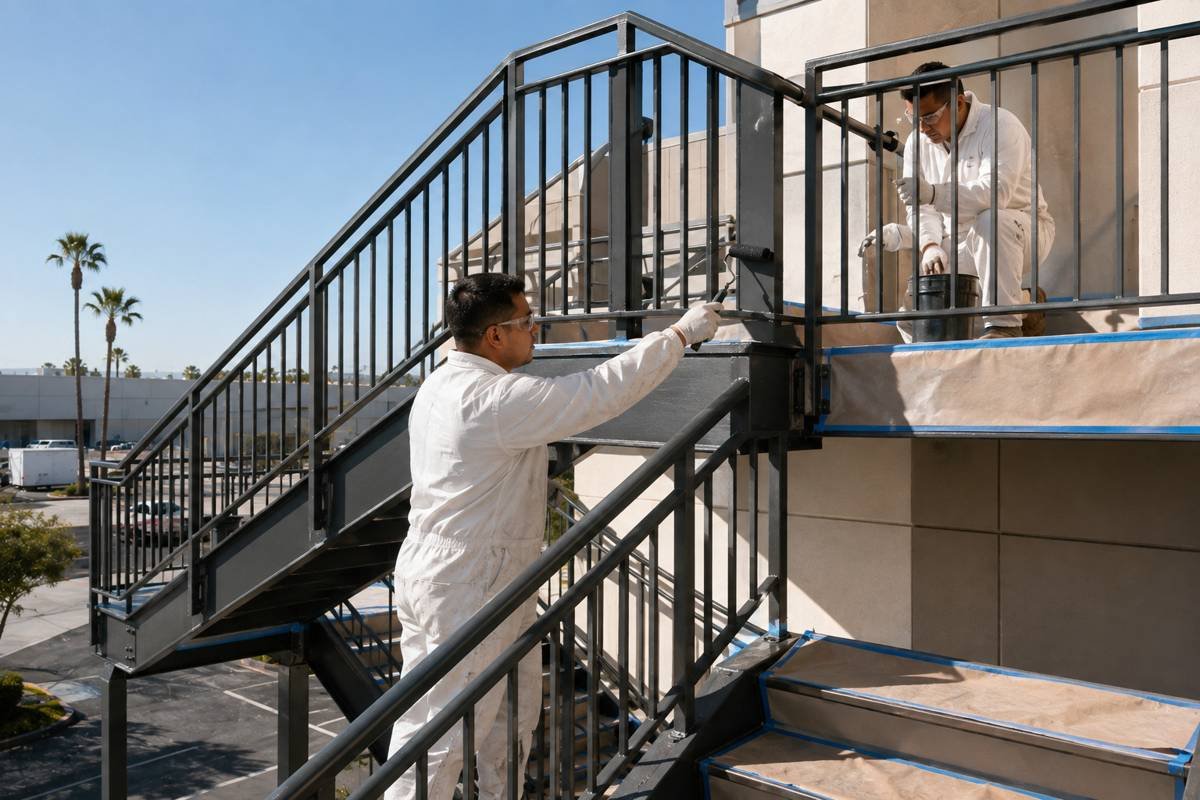
Specification follows exposure. Ferrous steel in a corrosive environment takes a zinc-rich primer, which protects galvanically: the zinc corrodes first and the steel underneath does not. Over it goes a high-build epoxy intermediate for barrier thickness, then a polyurethane or polyaspartic topcoat for UV stability and abrasion resistance.
Epoxy chalks in direct sun, so it belongs as an intermediate or in interior service. Polyaspartic cures fast and returns a surface to service in hours rather than days, which is why it earns its cost on a shutdown. Warehouse ceiling deck and structure is sprayed in a low-VOC acrylic or direct-to-metal system, usually white to lift light levels.
| Standard | What it allows | Where it applies |
|---|---|---|
| SP 5, white metal blast | No visible contamination | Immersion and severe service |
| SP 10, near-white blast | Light staining on up to 5% of each square inch | Exterior steel on this coast |
| SP 6, commercial blast | Staining on up to a third | Sheltered interior steel |
| SP 11, power tool to bare metal | Defined profile without blasting | Occupied buildings where blasting is impossible |
| SP 3, power tool cleaning | Loose material removed only | Maintenance recoats in mild service |
03
Film thickness, holiday testing and marine corrosion
A coating system is only what was actually applied.
Wet film thickness is checked with a comb gauge during application, dry film thickness with a magnetic or eddy current gauge against the specified range, in spot checks recorded per area rather than as one number for the job.
Holiday testing finds the pinholes an eye misses: wet sponge testing under about 20 mils, high-voltage spark testing on thicker tank linings. Every holiday is marked, repaired and retested, and the logs go into the closeout package.
Corrosion in a marine environment
Coating conditions here are set by salt-laden air and morning damp off Santa Monica Bay rather than by temperature. Within about a mile of the water, airborne chlorides settle on every exposed surface. Chlorides are hygroscopic: they hold moisture against steel and drive corrosion under the film even where the coating still looks sound.
That is why chloride washdown matters. Steel is pressure washed with clean water, a salt-removing detergent is used where the spec calls for it, and the surface is tested for soluble salts before blasting. Skip it and the contamination goes into the fresh profile, building a system over an active corrosion cell.
04
Floors, decks and fireproofing
Concrete floors are a preparation problem before they are a coating problem.
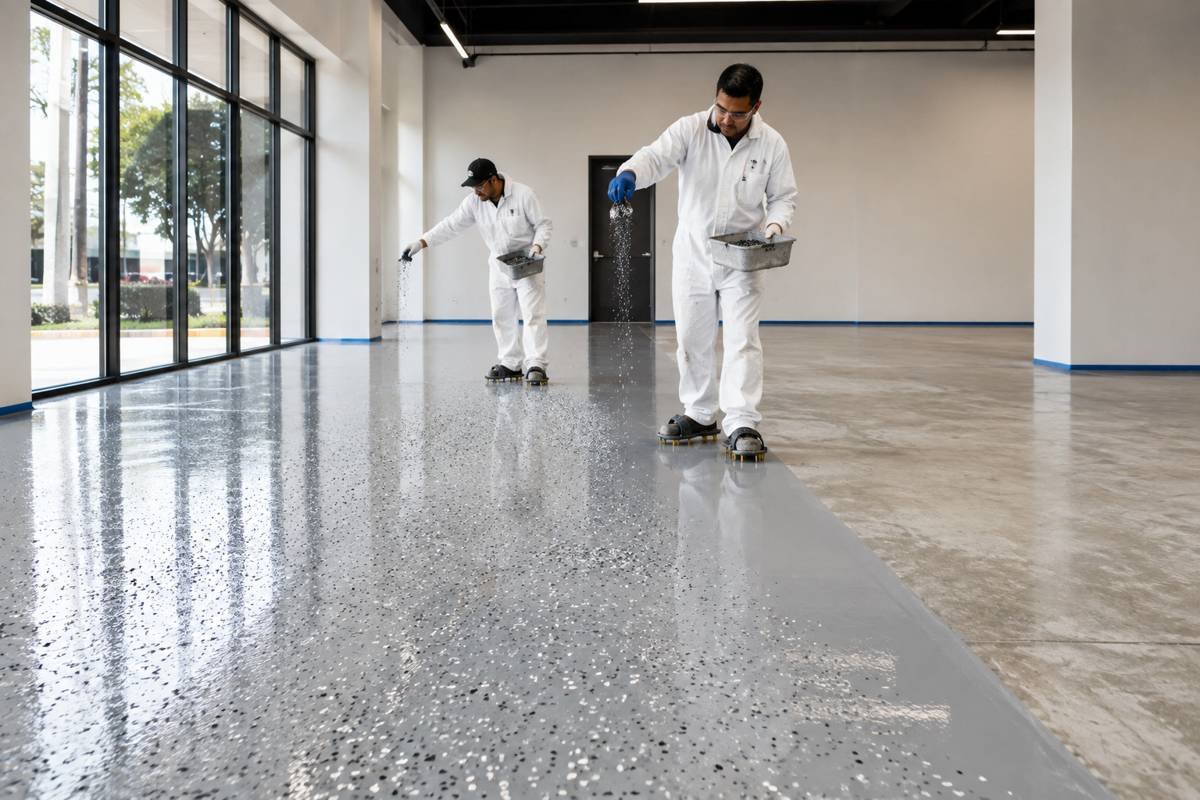
Epoxy is two-part resin and hardener mixed to a precise ratio, and bonds mechanically into a roughened surface, so the profile decides the result. Diamond grinding opens the surface, removes laitance and old coatings and gives a consistent profile for thin-film systems. Shot blasting is faster over large areas and leaves a deeper profile for high-build systems.
Moisture vapour testing happens before anything is applied. Calcium chloride or relative humidity probe testing tells you whether vapour drive through the slab will push the coating off. Slabs without an intact vapour barrier are common in older stock here, and they need a moisture-tolerant primer first.
Systems run from two-coat epoxy with a polyaspartic topcoat in warehouse areas, through flake broadcast for slip resistance, to urethane cement in wet and food-processing areas, where it takes thermal shock from hot washdown and resists organic acids from food waste.
Parking structure deck coatings
Traffic deck coatings do two jobs: waterproof the slab, and keep vehicle-borne chlorides away from the reinforcing steel. A typical system is a urethane base coat, an aggregate broadcast for slip resistance and a urethane wear coat. Deck work runs level by level so the structure keeps stalls in service, with crack routing, sealant, joint replacement and spall repair first. Line striping, stall numbering, directional arrows, ADA stalls and access aisles, curbs and bollards go back on at the end, to a plan approved before coating starts.
Intumescent fireproofing
Intumescent coatings expand under heat into an insulating char that holds structural steel below its critical temperature for a rated period. They suit exposed structural steel that has to be protected and still seen, common in converted industrial buildings. Thickness is not cosmetic: the applied dry film thickness delivers the rating, so it is inspected against the manufacturer's listing for that section size and recorded at closeout.
05
Containment, confined space and keeping the facility running
Blasting and spraying inside an occupied building is a containment job first.
We build negative-pressure enclosures, run HEPA-filtered exhaust and seal returns so nothing migrates into an adjacent tenant space, with lead-safe RRP practice on pre-1978 buildings.
Solvent-borne systems in an enclosed area need mechanical ventilation, air monitoring and respiratory protection. Tanks, vaults and pits are confined spaces: entry runs under a permit program with atmospheric testing, an attendant, retrieval equipment and continuous ventilation.
Very few of these buildings can close, and a distribution warehouse loses money by the hour. We phase by bay, aisle, level or production line, taking the smallest area that still leaves a workable zone. Floor work is scheduled against the operating calendar: a weekend shutdown, a holiday break, or a night window with the area handed back before first shift.
Our process and compliance
An estimator walks the facility with the plant or property manager, records substrate condition, coating adhesion, exposure, access and shutdown constraints, then measures surfaces by area and system. Repairs are carried at unit prices and the proposal is line-itemed with preparation standard, system, coats and specified dry film thickness. Submittals cover data sheets, a containment and ventilation plan, a confined space plan where relevant, and a schedule of values. Preparation is signed off before coating, DFT and holiday records are kept per area, and as-applied schedules, test logs, batch numbers and warranty documents are delivered at the end.
We hold California Contractor License #585047 (C-33 Painting and Decorating), carry general liability with umbrella coverage, and workers' compensation on every employee. Certificates naming the owner, management company and GC as additional insureds issue before mobilization. Architectural coatings comply with South Coast AQMD Rule 1113 VOC limits, and industrial maintenance products are specified within the applicable Rule 1113 category limits.
How protective coatings are priced
Per square foot of coated surface, or per contract on a facility package, with repairs at unit prices. What moves it: the preparation standard, since an SP 5 blast costs several times an SP 3 clean, containment and ventilation, coating system and film build, access, moisture mitigation, after-hours labour, prevailing wage, and how small the phasing zones have to be.
Scheduling, lead time and capacity
Floor packages under 20,000 square feet mobilize two to three weeks after award. Steel and deck contracts book four to eight weeks out, and shutdown work is held against the facility's calendar, usually a weekend booked months ahead. Dew point and humidity govern application windows, so exterior steel starts later in the day from May through July when the marine layer holds.
06
Industrial property in Santa Monica
The industrial stock here is small, converted and close to the water.
Bergamot Station is the clearest case: former industrial buildings with exposed steel, sawtooth roof framing and slab floors, now in gallery and creative office use, where steel needs corrosion protection and a finish somebody looks at.
Structured parking is the larger volume. The Water Garden and Colorado Center campuses, the Santa Monica Place garages and the Ocean Avenue hotel corridor run multi-level decks under continuous use, taking chloride off the bay and salt tracked in on vehicles. Saint John's Health Center and UCLA Santa Monica Medical Center add back-of-house slabs and plant rooms where downtime is measured in hours.
07
Frequently asked questions about protective coatings
What preparation standard should our spec call for?
SP 10 near-white blast for exterior steel on this coast, SP 6 for sheltered interior steel, and SP 11 power tool cleaning to bare metal where blasting is impossible. SP 5 is reserved for immersion and severe service.
How do you prove the coating was applied to spec?
Dry film thickness readings recorded per area against the specified range, holiday test records where a continuous film is required, batch numbers and an as-applied schedule, all at closeout. Coatings meet SCAQMD Rule 1113 VOC limits.
Do we need moisture testing before an epoxy floor?
Yes, calcium chloride or relative humidity probe testing before anything goes down. Slabs without an intact vapour barrier need a moisture-tolerant primer, and skipping it is the most common cause of a failed floor.
When is urethane cement the right floor system?
In commercial kitchens, food processing, cold storage and anywhere hot washdown happens. It handles the thermal shock and organic acids that lift a standard epoxy.
Can the facility keep operating during the work?
Yes. We phase by bay, aisle, level or line, work nights, weekends and shutdown windows, and specify fast-cure polyaspartic where return-to-service time binds.
How do you control dust and fumes in an occupied building?
Negative-pressure containment with HEPA-filtered exhaust, sealed returns, source capture on prep tools, air monitoring for solvent work, and permit-controlled entry in confined spaces.
08
Related commercial services
Owners running mixed portfolios can hand a site list to an estimator and work outward from the facility type.
Request a protective coatings bid
Send the facility address and type, surface area and substrate, service environment, existing coating information and your shutdown window. We walk the site and return a line-item proposal with a phasing plan.
- DFT and holiday test records at closeout
- Return-to-service date designed in
- Licensed, insured and bonded