
Our bathroom painting project came out beautifully. Clean edges and a flawless finish!
HOA and Condo Association Painting in Santa Monica, CA
Santa Monica Expert Painting is Los Angeles County's commercial painting contractor for community associations, working with HOA boards, community managers and management companies on multi-building exterior repaint programs, clubhouse and common-area interiors, and wood trim, railing and stair-tower coatings. We handle 20-door single-building associations through 400-door communities across 12 buildings, all occupied through the work. Fully licensed, insured and bonded.
From a bid package a board can set beside two competing proposals and read line for line, to the warranty binder filed with the association's records at closeout, our team handles the parts of a commercial job that decide whether it finishes on schedule.
Serving Santa Monica and the surrounding Los Angeles County market, we work to the board's approved calendar, run evening and weekend hours where the property requires it, and turn each phase over ready for walkthrough and sign-off.
- Line-item bid with unit prices
- Colour drawdowns on real elevations
- Homeowner notice built into the plan
- Licensed, insured and bonded
Reviews
What boards and managers say about the work
We needed our office repainted without creating a major disruption for employees. Santa Monica Expert Painting handled the project efficiently and gave the entire workspace a brighter, more professional appearance.
The painters took great care around our furniture, flooring, and fixtures. Our walls and ceilings look fantastic, and there were no drips or messy edges left behind.
Our new accent wall looks perfect. It completely changed the feel of the room.
Santa Monica Expert Painting helped us choose colors that complemented our flooring and natural lighting. The finished interior feels warm, coordinated, and much more inviting. We are extremely happy with the transformation.
Beautiful exterior painting and excellent workmanship from beginning to end.
We hired the team to paint several units in our rental property. The walls, doors, and trim were finished neatly, and each space looked fresh and ready for new tenants. The results made a noticeable difference.
Our commercial storefront needed an update, and Santa Monica Expert Painting delivered exactly what we wanted. The new color scheme looks clean and professional, giving the building a much stronger street presence.
01
Scope and project size
Association work runs from 20 doors to 400, across 2 to 12 buildings under one set of governing documents.
A 28-door association off Fourth Street is a five to seven week exterior. A 340-door community of nine buildings splits across two or three fiscal years.
Scope follows the governing documents: stucco, siding, fascia, trim, entry doors, balcony rails, stair towers, corridors, clubhouse interiors, pool decks and garage areas. Owner-side interiors stay out unless the board votes them in.
| Buyer | Situation |
|---|---|
| Boards | Funding an exterior repaint from a current reserve study |
| Community managers | Running Westside association portfolios |
| Architectural committees | Reviewing a colour change before a membership vote |
| Associations of 2 to 12 buildings | Needing a phased multi-year contract |
| Boards comparing bids | Three RFP responses written in three formats |
02
From site walk to closeout
The board sees every step.
A walk of each elevation, stair tower, corridor and common structure with the manager. A takeoff giving square footage by building and linear feet of rail, trim and fascia. A line-item bid with unit prices for repair. Submittals covering products, colour drawdowns, insurance, schedule and phasing. Then mobilization, weekly reporting, a punch walk per building, and closeout.
Closeout is a package the association files: as-painted colour schedules by building and surface with manufacturer codes and sheens, product data sheets, the written labour warranty and its term, the manufacturer's material warranty, the unit-price reconciliation, and labeled attic stock.
The reserve study and the repaint cycle
Exterior paint is a reserve component with a useful life, a remaining life and a funded replacement cost. The study carries a year for it, and we bid against that line rather than around it.
Two things break the study's assumption here. Salt air off Santa Monica Bay shortens exterior cycles, so an ocean-facing elevation in Ocean Park hits its threshold years before a sheltered courtyard face does. And a component funded at a 2019 cost does not buy a 2026 repaint. Where the balance falls short, boards phase the community across funding years and take the windward buildings first. We supply the condition evidence and per-building pricing behind that call.
03
Specifications, bid comparison and board approval
Three bids arrive. One quotes two coats, one a single coat over spot prime, one does not say. The cheapest number is usually the smallest scope.
Apples-to-apples comparison needs one written specification that every bidder prices, and we will help a board or manager draft one. It needs seven items: preparation by method, coat count and mil thickness, named products and sheen by surface, a stated linear-foot allowance for cracks and sealant, a dry rot unit price, colour count, and the warranty term in years. Put those on one bid form in one order and the board compares contractors instead of paragraphs.
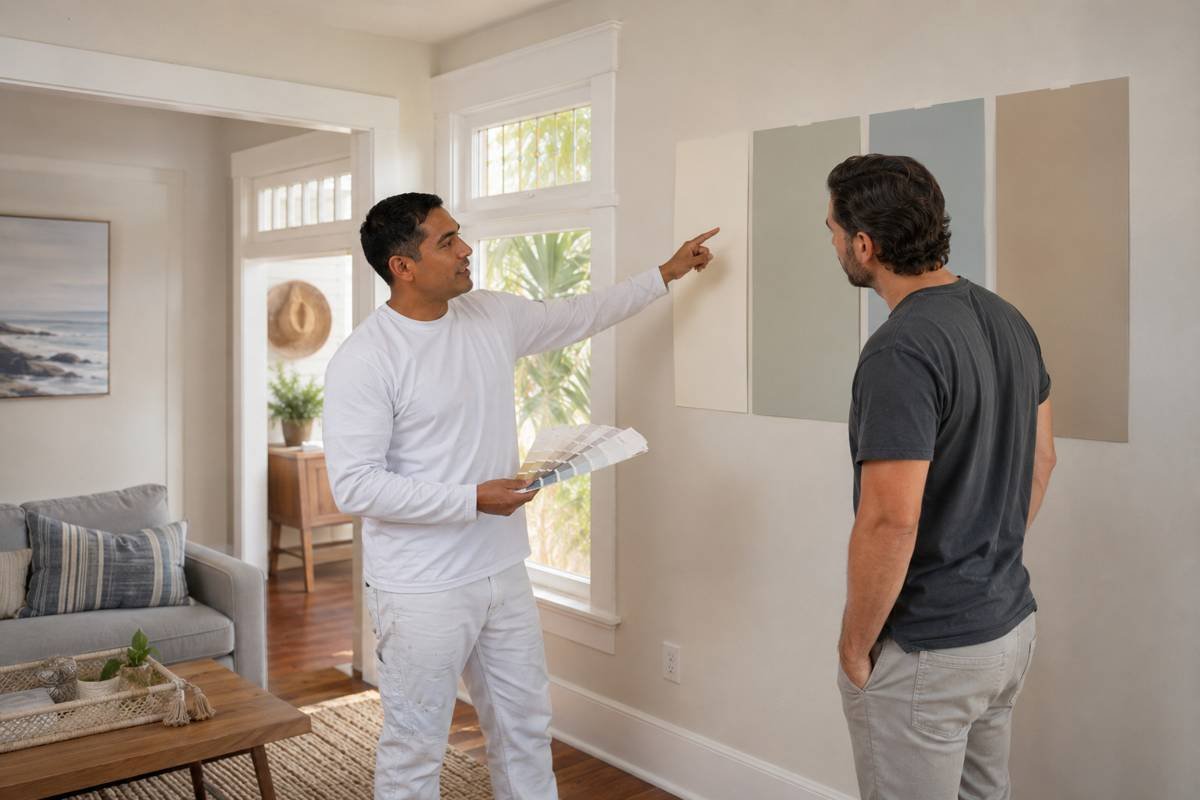
Colour goes to the architectural committee as physical sample boards, not printed swatches. Sheen shifts colour, stucco texture shifts it again, and marine-layer morning light reads a chip nothing like the 3pm sun does. We supply drawdowns in the actual product and sheen, paint a mock-up on a real elevation, and present scope, schedule and phasing to the board in one sitting, with approved colours locked to manufacturer codes in the contract.
04
Multi-year phased contracts across buildings
Communities of 4 to 12 buildings rarely repaint at once.
A phased contract awards the full scope at a fixed per-building price across two to four fiscal years, so the board locks pricing and sequence now and pays out of years it has funded.
Sequencing follows exposure, not building numbers. Escalation is written in as a stated annual percentage rather than left open, each phase closes with its own punch walk and warranty start date, and the colour schedule carries forward so building nine matches building one.
Homeowner communication in an occupied association
Owners are not tenants. They vote, they attend meetings, and they call the manager when a ladder appears unannounced.
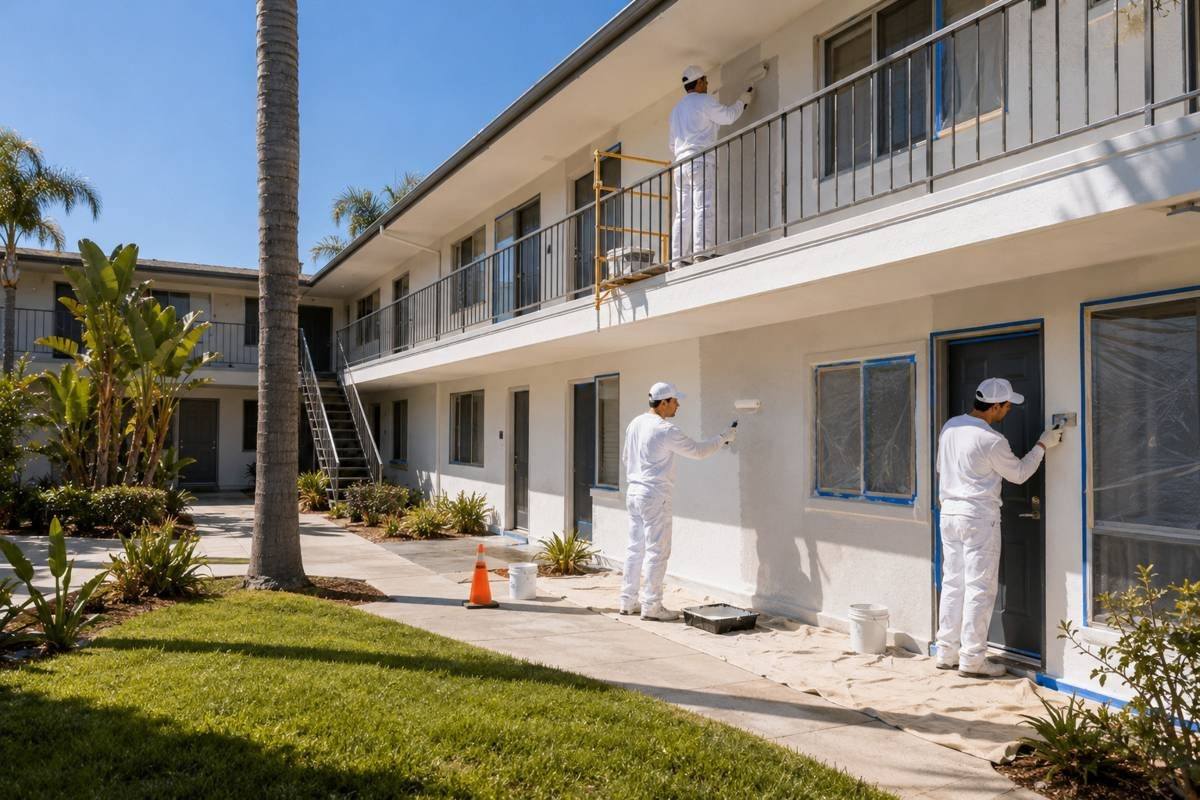
Written notice goes out 10 to 14 days before a building's phase and again 72 hours before work reaches an elevation, posted at entries and delivered door to door. Balcony and patio clear-off stalls more schedules than weather does, so owners remove furniture, planters, screens, hanging plants and anything mounted to the rail by a posted date, with a follow-up date for units that miss it. Satellite dishes are photographed in place, then detached and reset by the association's provider or coated around where the license forbids removal. Landscape beds are covered, irrigation is shut off during washing, and stalls close only in posted hours.
05
Common areas and the systems specified on them
Common areas are where owners see the money.
Clubhouse and lobby interiors take eggshell or satin 100% acrylic, with washable waterborne alkyd on doors, frames and casework. Pool-deck fencing, gates and equipment enclosures sit in chlorine and salt at once, so they take a direct-to-metal system over a rust-inhibitive primer. Subterranean garages get ceiling and wall coatings, striping, curb and bollard safety colours and stall numbering, with a light-reflective ceiling because a dark garage draws security complaints. Stair towers are one assembly: walls, risers, stringers, undersides and handrails in a single mobilization, treads and landings in a slip-resistant traffic coating.
On the envelope, sound stucco takes high-build 100% acrylic over a masonry conditioner and widespread hairline cracking takes elastomeric at the manufacturer's wet mil rate.
Wood trim and dry rot as a unit-price allowance
Nobody knows how much fascia is rotten until the paint comes off, and boards get hit with change orders because contractors bid the visible damage and invoice the rest.
Wood repair sits in the original contract as unit prices: a rate per linear foot of fascia, per trim or siding board, per railing post and per stair tread, against an allowance the board approves up front. Use 60% of the allowance and the association pays 60%. Every replacement is photographed, logged by address and reconciled with each progress invoice. Past the allowance, work stops for written board approval.
Credentials, insurance and additional-insured requirements
We hold California Contractor License #585047 (C-33 Painting and Decorating), carry general liability with umbrella coverage, and maintain workers' compensation on every employee. Certificates of insurance naming the association, the management company and any lender as additional insureds are issued before mobilization, with waiver of subrogation and primary and non-contributory wording where the CC&Rs require it. A W-9 goes to the manager with the executed contract. Crews are RRP-certified for pre-1978 buildings and coatings meet SCAQMD Rule 1113 VOC limits.
How association contracts are priced
Per contract with measured square footage behind it, split by building for phasing, with repair carried as unit prices. What moves it: door and building count, access method, coat count, colour change, linear feet of rail and trim, crack and sealant volume, and how tightly phasing is cut around owner access.
Scheduling, lead time and capacity
Association exteriors book six to ten weeks out, because the board vote, the colour approval and the notice period sit ahead of mobilization. November through March, the marine layer and rain push starts later and cost usable hours, which is why most Westside boards target an April to October window. Interiors mobilize two to three weeks after award.
06
Santa Monica's condo and association stock
A city of 47,438 households, 72.9% of them renter-occupied, keeps its owner-occupied condominium stock concentrated.
Ocean Avenue and the blocks behind it, Downtown north of the Third Street Promenade, the courtyard associations of Ocean Park, and the mid-rise Wilshire Boulevard corridor.
Salt air off Santa Monica Bay drives chalking, rust bleed at rail connections and film failure on windward elevations years ahead of the same building's protected faces. Inland associations can plan a ten to twelve year cycle. Boards a few blocks from the beach should plan seven to eight and fund the reserve line to match.
07
Frequently asked questions about association painting
How many doors and buildings can you take on?
From 20 doors to 400, across 2 to 12 buildings, bid per building so the award can be phased across funding years.
How is an HOA repaint contract priced?
Per contract with measured square footage behind it, split by building for phasing, and repair carried as unit prices. A line-item proposal follows the walk.
Will you help us write the specification before we go out to bid?
Yes. We draft the scope: preparation, coat count, mil thickness, named products, allowances, the dry rot unit price and the warranty term.
Do you present to the board and the architectural committee?
Yes, with drawdown boards in the actual product and sheen and a mock-up painted on the building before a scheme is approved.
How are owners notified, and what about dishes, plants and parked cars?
Written notice 10 to 14 days before a phase and 72 hours before an elevation, with balcony clear-off dates. Dishes are photographed and reset, landscape is covered, and stalls close only in posted hours.
How do you keep dry rot from becoming a change order?
It is carried as unit prices against a board-approved allowance, logged by address and reconciled on every progress invoice.
What insurance documents does our management company get?
A certificate naming the association, the management company and any lender as additional insureds, with waiver of subrogation and primary and non-contributory wording, plus a W-9.
08
Related commercial services
Managers holding several communities can start from the services overview and work outward from the property type.
Request an HOA or condo association painting bid
Send the association name, door count, building count, the reserve-study year the repaint is funded against and your phase window. We return a line-item proposal with a phasing plan, a colour package and unit prices for wood repair.
- Written specification and phasing plan
- Colour package the board can vote on
- Licensed, insured and bonded