
Great work on our doors, baseboards, and interior trim. Every line looks crisp and precise.
Deck and Fence Staining in Santa Monica, CA That Survives Salt Air and Sun
Santa Monica Expert Painting is Los Angeles County's trusted expert in exterior wood finishing, specializing in deck staining, fence staining, and full wood restoration. We offer semi-transparent stain application and solid-colour deck coatings, with strip, sand and brighten preparation before any finish goes down. Fully licensed, insured and bonded.
From board-by-board fastener inspection to a full-scope railing, post and substructure refinish, our team handles every detail. Serving Santa Monica and nearby Pacific Palisades, Brentwood and Malibu, we walk the wood, test its absorption, and tell you whether it needs a stain, a restoration, or replacement boards first.
- Free estimate, absorption tested
- Penetrating stain, not a peeling film
- Loose boards and fasteners fixed first
- Licensed, insured and bonded
Reviews
What clients say about our deck and fence work
Santa Monica Expert Painting transformed our older home with fresh interior and exterior paint. The preparation work was thorough, the color coverage was consistent, and the finished surfaces look outstanding. The entire property now feels well maintained and updated.
Santa Monica Expert Painting did a beautiful job repainting the interior of our home. The rooms look brighter, cleaner, and completely refreshed.
Excellent painting and careful preparation. Our house looks amazing!
We hired Santa Monica Expert Painting to repaint our living room, kitchen, and hallway. The lines around the trim and ceilings came out incredibly clean, and the new colors transformed the entire space. Everything was left neat when the work was finished.
Our home’s exterior looks brand new again. The finish is smooth, even, and professionally done.
The team painted our kitchen cabinets, and we couldn’t believe the difference. The doors and drawers have a smooth, factory-like finish, and the new color made our entire kitchen feel more modern.
Friendly service, beautiful results, and great attention to detail.
01
Deck and fence staining services we provide
Wood on the Westside ages faster than wood four miles inland.
Deck staining and sealing
Horizontal surfaces take the abuse. We strip failed coatings, sand the traffic surface flat, brighten the wood, then apply stain at the rate the boards will actually accept. Stairs, landings and handrails get the same attention as the field.
Fence staining and refinishing
Fences are vertical, which is the biggest reason they outlast decks. We stain both faces where access allows, treat the ground contact zone at the post base, and coat cap rails and lattice separately.
Deck restoration and board replacement
When more than a handful of boards are cupped, split or soft, staining alone is a waste of money. We replace the failed boards, reset popped fasteners, check the joists and ledger, then finish the surface as one.
Railing, post and pergola work
Railings, newel posts, pergola beams and privacy screens are a different exposure than the deck floor. They often need a different product or interval, and we price them that way.
Pressure washing and wood brightening
Cleaning is not preparation, but it is part of it. We use controlled pressure so the soft spring wood does not furr up, then a brightener to pull the grey back.
02
Wood species, stain types and systems
Three species cover almost every deck and fence in the 90402 through 90405 ZIP codes, and each drinks stain differently.
Redwood
The local classic. Dimensionally stable, rot resistant in the heartwood, and it holds semi-transparent stain beautifully because the grain is open and even. It is also soft, so aggressive pressure washing carves it.
Western red cedar
Behaves similarly but is more prone to tannin bleed, especially where water sits against a fastener. Cedar fences on the Ocean Park and Sunset Park side of town often show black streaks that are chemistry, not mildew.
Pressure-treated pine
The budget substrate and the fussy one. New treated lumber is often still wet from the treatment process and rejects stain until its moisture content drops. A sprinkle test tells you: if water beads, the wood is not ready.
| System | What it does | Grain visibility | Estimated recoat interval |
|---|---|---|---|
| Transparent / clear sealer | Water repellency, almost no pigment | Full grain, natural tone | 1 year on decks |
| Semi-transparent stain | Pigment plus penetration, some UV block | Grain fully visible, tinted | 2 to 3 years on decks, 3 to 5 on fences |
| Semi-solid stain | Heavier pigment load, more UV defense | Grain texture visible, colour dominant | 3 to 4 years on decks |
| Solid colour stain | Opaque film, maximum UV block | Grain texture only, no figure | 4 to 6 years on fences |
| Oil-based penetrating | Soaks into fibre, no surface film | Depends on pigment load | Recoats without stripping |
| Waterborne / acrylic | Sits closer to the surface, faster dry | Depends on pigment load | Longer, but can peel |
That table is the whole trade-off. Pigment is what stops ultraviolet light, so the more you add, the longer the finish lasts and the less of the wood you see. A clear sealer on a redwood deck here looks superb in April and grey by the following spring. A solid stain still looks intentional in year four, but you have effectively painted the deck.
Oil-based penetrating stains soak into the fibre and fail by eroding, so the next coat goes over a clean, worn surface. Waterborne products cure harder and resist abrasion better, but they build a film nearer the surface and can peel rather than erode if moisture pushes from behind. Both have a place. On a west-facing deck we usually lean oil. On a fence a homeowner wants in a specific colour, waterborne solid stain is often the better answer. South Coast AQMD Rule 1113 governs VOC content on every product we carry.
03
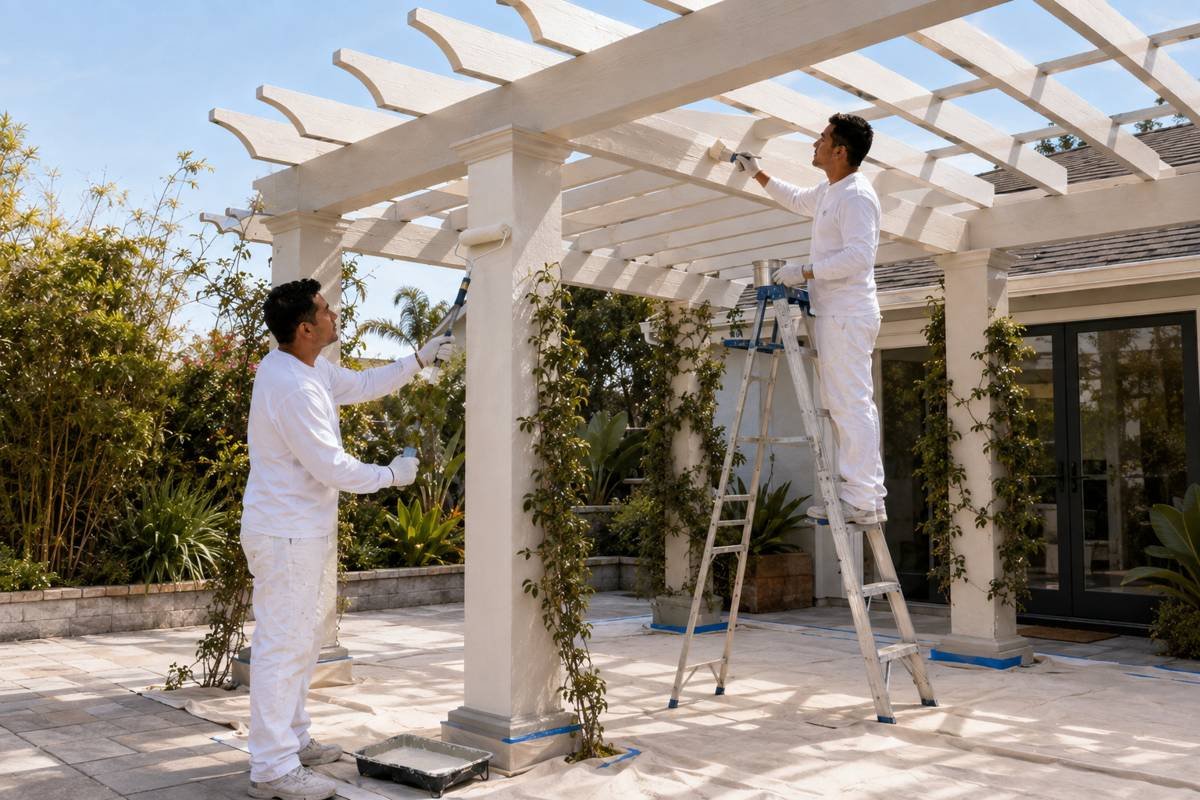
Our deck and fence staining process
Eight stages, and in a June Gloom week the drying stage can mean waiting two or three extra days. We would rather wait.
Assessment
We check moisture content, test absorption, probe for rot at post bases and ledger connections, and count the boards that need replacing.
Strip
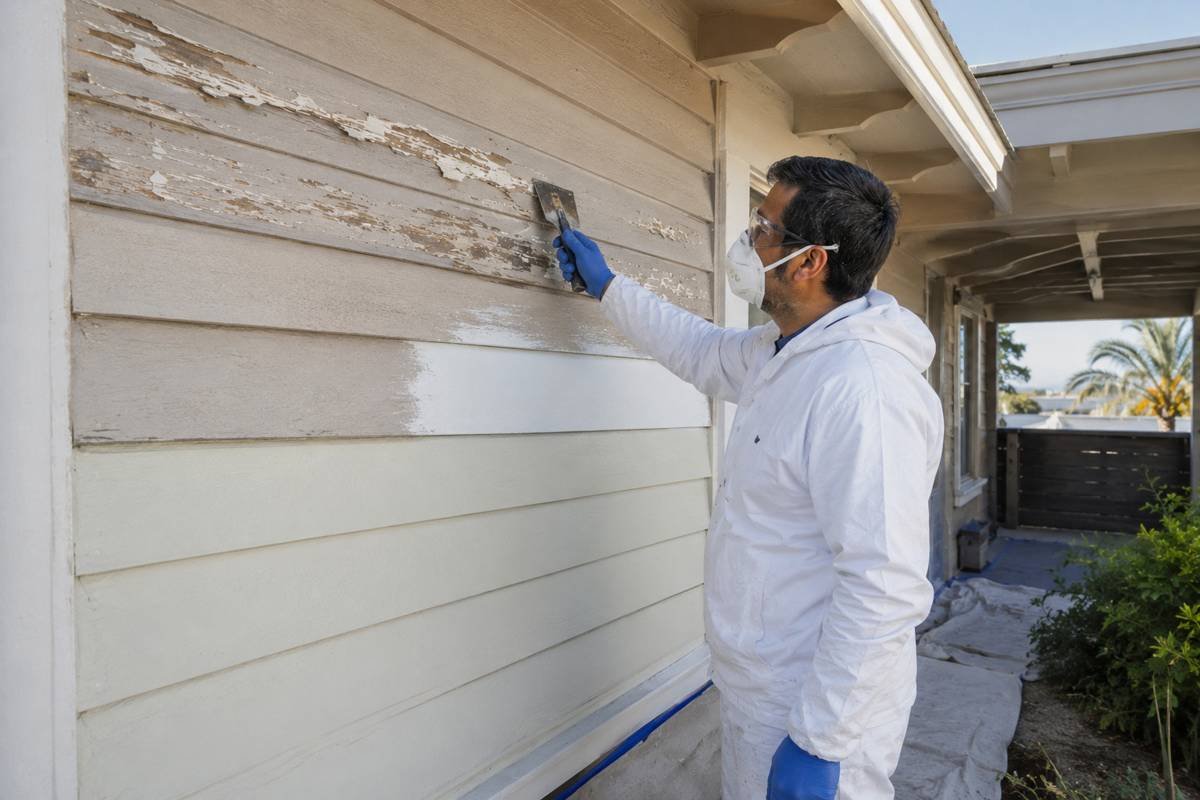
Any failed film-forming coating comes off. A new stain over a peeling old one fails on the old one's schedule.
Sand
Decks get sanded to flatten raised fibre. Over-sanding closes the grain and blocks penetration.
Brighten and neutralize
Oxalic acid restores colour and resets pH, which lets the stain cure properly.
Dry
We will not stain damp wood, so the schedule flexes around the marine layer.
Repair
Board swaps, fastener resetting, countersinking, and structural notes go here.
Stain
Applied to refusal on penetrating products, back-brushed on every board, end grain fed until it stops taking material.
Cure and inspect
We walk the job with you and note the recoat date.
04
Why a deck fails faster than a fence
A fence finish routinely lasts twice as long as the same product on a deck fifteen feet away.
A deck lies flat. It catches every hour of sun the sky delivers, it holds water after the marine layer condenses overnight, and people walk on it. A fence sheds water and nobody scuffs it with patio furniture. Near the Third Street Neighborhood Historic District you see it constantly: a 1920s bungalow's fence looks fine while the back deck has gone silver.
Grey-out is ultraviolet degradation of lignin, the glue holding the wood fibres together. Once lignin breaks down the surface fibres let go, which is why weathered wood feels fuzzy. With roughly 310 days of sunshine a year, unpigmented wood greys fast. Mildew comes from the opposite direction: the marine layer locals call May Gray and June Gloom keeps surfaces damp for hours after sunrise, and mildew feeds on the oils in some stains. Shaded side yards near Lincoln Boulevard are the usual suspects.
Salt is the third factor. Air within a mile of the Santa Monica Pier carries chloride, which corrodes fasteners and leaves black streaks around every screw head. That chemistry drives our approach to ocean-facing repaints on coastal exposures.
When a deck should be painted instead of stained
Sometimes the right answer is paint. If a deck is already painted, if the boards are degraded pressure-treated lumber that will not take stain evenly, or if you want a colour stain cannot deliver, a deck paint system over the correct primer outperforms stain on appearance and interval.
Understand what you are agreeing to. Paint and solid stain form a film on top of the wood rather than living inside it. When that film fails, and it will, moisture is trapped underneath and the coating peels in sheets. Getting back to bare wood then means chemical stripping and sanding, or replacing boards outright. Stain to paint is a one-way door. We say that plainly before you decide, the same way we do on exterior siding and trim repaints.
05
Sealers, recoat intervals and maintenance
Maintenance coats are cheap on schedule and expensive when skipped, because a fully failed stain becomes a strip job.
A sealer without pigment does one job: repelling water. It does very little about UV, so treat clear products as a one-year item on a deck. Semi-transparent on a deck here wants a maintenance coat every two to three years, a fence every three to five.
Two habits extend everything. Move the planters, because a wet pot sitting in one spot for a year rots the board under it, and rinse salt off any deck near the water through the dry season.
Why Santa Monica homeowners choose us
We are fully licensed, insured and bonded, and certificates go to you before we start. We use products meeting SCAQMD Rule 1113 limits, one crew stays on the job from start to finish, and surface prep is documented before coating. On pre-1978 properties we follow EPA RRP lead-safe containment.
What shapes the estimate
Square footage and railing linear feet, whether an old film coating has to be stripped, how many boards get replaced, access, since a roof deck off Ocean Avenue is not a ground-level patio in Mid-City, species and condition, and whether the substructure needs work first.
06
Frequently asked questions about deck and fence staining
How long does deck staining take?
Most residential decks run two to four working days including dry time. Fences are often one to two. A heavy marine-layer week adds a day, because we will not stain damp wood.
Can you stain a brand-new pressure-treated fence?
Usually not right away. New treated lumber holds too much moisture to accept stain. If water beads on the surface, we recommend waiting, sometimes several weeks.
Do I need to strip the old stain first?
If the old product is a penetrating oil that has worn thin, often no. If it is a solid stain or a peeling film, yes. Coating over a failing film guarantees the new coat fails with it.
Which lasts longer, oil or water-based stain?
Neither wins outright. Oil erodes gracefully, which makes recoats simpler. Waterborne resists abrasion and holds colour but can peel if moisture pushes from underneath.
Will staining hide the grey on my deck?
Brightening removes most of it and pigment covers the rest. Weathered boards may need sanding, and degraded boards are better replaced.
How often should I recoat?
Two to three years for a stained deck here, three to five for a fence, one year for anything clear. Sun exposure moves those numbers most.
Can you replace rotten boards as part of the job?
Yes. Board replacement, fastener resetting and railing repairs are normal parts of a restoration, identified during the estimate, not mid-project.
Do you stain both sides of a fence?
Where we have access, yes. A fence stained on one face weathers unevenly and can cup.
07
Related services and service areas
We stain decks and fences across every Santa Monica neighborhood, from North of Montana and the Montana Avenue corridor to Sunset Park, Ocean Park, Mid-City and Main Street. Roof decks along Ocean Avenue are regular work.
- Garage Floor Epoxy Coating
- Brick & Masonry Painting
- Interior House Painting
- Exterior House Painting
- Marine & Coastal Exterior Repaint
- Stucco Painting
Every painting service we offer.
Service areas
Canyon decks and bluff exposure in Pacific Palisades, redwood and cedar under the hardest salt exposure in Malibu, and estate-scale deck runs with cedar fencing in Brentwood. Our coverage map across the Westside and South Bay lists every city we serve.
Get a free deck and fence staining estimate
We measure, test the wood, name the system that fits your exposure, and hand you a written scope with an honest recoat schedule.
- Free written estimate
- Cleaned and brightened before staining
- Licensed, insured and bonded