
The painters took great care around our furniture, flooring, and fixtures. Our walls and ceilings look fantastic, and there were no drips or messy edges left behind.
Historic Home Restoration Painting in Santa Monica, CA That Keeps the Original Building Intact
Santa Monica Expert Painting is Los Angeles County's trusted expert in historic home restoration painting, specializing in lead-safe surface preparation, paint archaeology and colour matching, and hand-scraping of original wood. We offer lime and mineral coatings, wood window sash restoration, and consolidation of weathered trim. Fully licensed, insured and bonded.
From reading a paint stratigraphy sample under magnification to a fully scaffolded exterior restoration, our team handles every detail. Serving Santa Monica and nearby Pacific Palisades, Beverly Hills and Palos Verdes Estates, we work at the pace the building needs, separating original fabric from later repairs before anything is quoted.
- Free condition survey
- Hand preparation, never blasting
- Original wood repaired before replaced
- Licensed, insured and bonded
Reviews
What owners of older homes say about the work
Our new accent wall looks perfect. It completely changed the feel of the room.
Santa Monica Expert Painting helped us choose colors that complemented our flooring and natural lighting. The finished interior feels warm, coordinated, and much more inviting. We are extremely happy with the transformation.
Beautiful exterior painting and excellent workmanship from beginning to end.
We hired the team to paint several units in our rental property. The walls, doors, and trim were finished neatly, and each space looked fresh and ready for new tenants. The results made a noticeable difference.
Our commercial storefront needed an update, and Santa Monica Expert Painting delivered exactly what we wanted. The new color scheme looks clean and professional, giving the building a much stronger street presence.
The ceiling painting came out smooth and even. The room feels much cleaner and brighter now.
We had peeling paint and minor surface damage on the outside of our home. The team prepared the problem areas carefully before applying the new paint. The finished exterior looks smooth, durable, and professionally restored.
01
What we restore on Santa Monica's older homes
Ocean Park and the streets around it hold a dense run of pre-1930 housing, and none of it behaves like new construction. Interior millwork, picture rail and plaster get the same treatment as the exterior.
Exterior wood: siding, corbels and rafter tails
Exposed rafter tails and knee braces fail first on a 1910 bungalow, because end grain drinks water. We cut back to sound wood, consolidate soft fiber with penetrating epoxy, shape rather than replace, and prime the day a surface is opened.
Wood window sash and original glazing
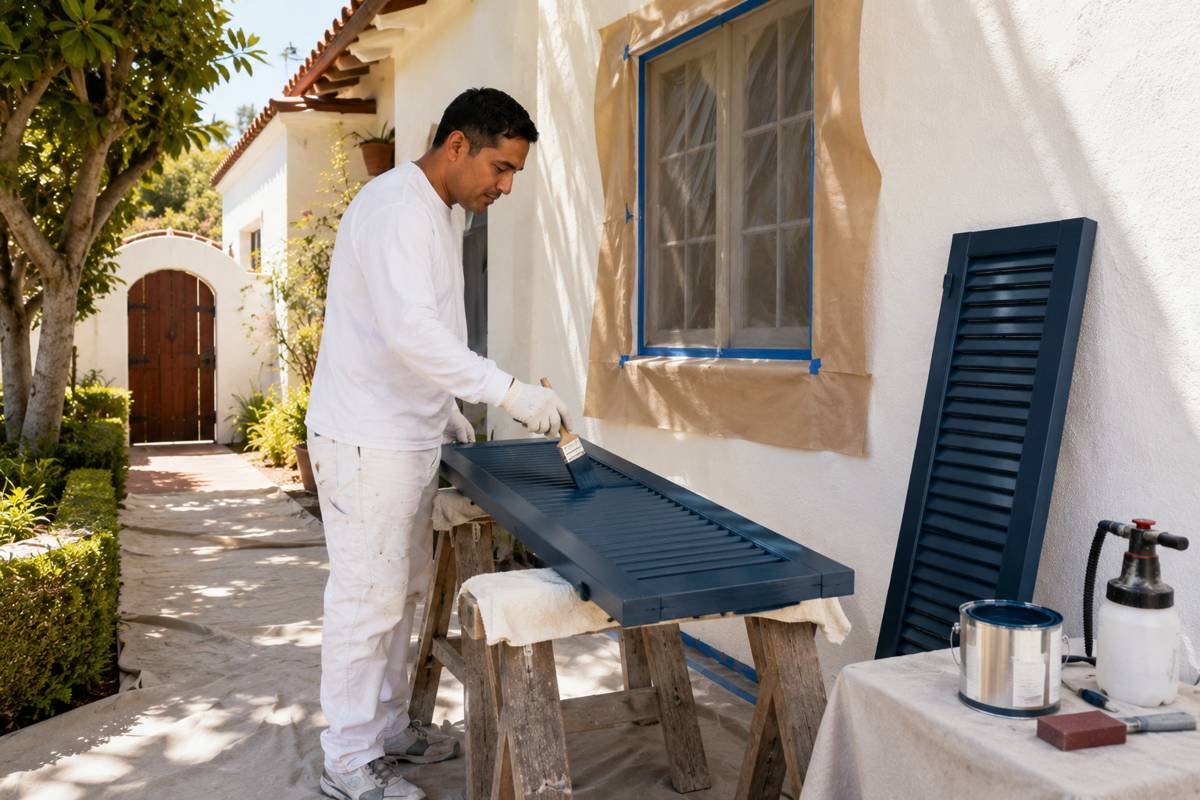
Original sash is old-growth wood and worth saving. We strip failed putty, reglaze in linseed oil putty, ease the sash so it runs again, and finish in waterborne alkyd enamel that meets South Coast AQMD Rule 1113 limits.
Original lime and cement stucco
Traditional lime stucco breathes and self-heals slightly, because lime is faintly water soluble. We patch with compatible material rather than a hard portland mix that would crack the softer original, then coat it breathable.
Lead-safe preparation on pre-1978 houses
Anything built before 1978 is treated as lead-bearing until testing says otherwise. Containment, HEPA vacuums and wet methods are standard.
| System | Where it goes | Why it is specified |
|---|---|---|
| Limewash (slaked lime in water) | Original lime stucco, brick, bare masonry | Absorbed, cures by carbonation, stays breathable |
| Potassium silicate mineral paint | Stucco facing weather | Vapor permeable, resists driven rain |
| Waterborne alkyd enamel | Sash, doors, corbels, rails | Oil-like flow and hardness, low VOC |
| 100% acrylic latex | Later siding, fascia, trim | Flexible, chalk resistant under coastal UV |
| Alkyd stain-blocking primer | Redwood, cedar, knots | Stops bleed-through on aged wood |
| Epoxy consolidant and filler | Soft rafter tails, sills | Saves original material |
Sheens follow the period. Flat or matte on stucco and siding bodies, satin on trim, semi-gloss on sash. We do not put elastomeric over original lime stucco, because a thick film traps moisture in a wall built to release it.
02
Our restoration process, step by step
Eight stages, ending in a written record of products, colours and photographs for your file or a Landmarks Commission submittal.
Condition survey
Elevations photographed, failures mapped by type: peeling, alligatoring, rot, efflorescence.
Testing and paint archaeology
Lead testing on pre-1978 surfaces, plus stratigraphy samples cut and read.
Containment
Ground sheeting, sealed openings, negative pressure where required, daily verified cleanup.
Hand preparation
Scraping, carbide work, infrared softening, feather sanding. No abrasive blasting.
Substrate repair
Consolidation, dutchman repairs, compatible stucco patching, sash reglazing.
Priming
Spot or full prime by substrate, applied the day bare material is exposed.
Finish coats
Two coats brushed or sprayed and back-rolled, after a mock-up is approved.
Closeout
Walkthrough, touch-up, and the written product and colour record.
03
The Third Street Neighborhood Historic District and what designation changes
Designation does not stop you painting. It changes how the decision gets made.
Santa Monica designated the Third Street Neighborhood Historic District on July 1, 1990, the city's first. It runs between Ocean Park Boulevard and Hill Street across Second, Third and Beach streets, and holds 38 contributing buildings put up between 1875 and 1930. Twenty-seven are bungalows built from 1903 to 1915. Spanish Colonial Revival bungalow courts from the mid-1920s to the early 1930s sit among them, with the 1893 Hostetter House.
The Landmarks Commission reviews work on designated resources, and the Santa Monica Conservancy is an active voice on what happens to them. We prepare submittal-ready colour documentation, keep samples on site, and schedule around approval. The Bay Street Beach Historic District, listed on the National Register in 2019, carries its own expectations.
04
Hand-scraping, consolidation and paint archaeology
Media blasting is fast and it is the wrong tool here.
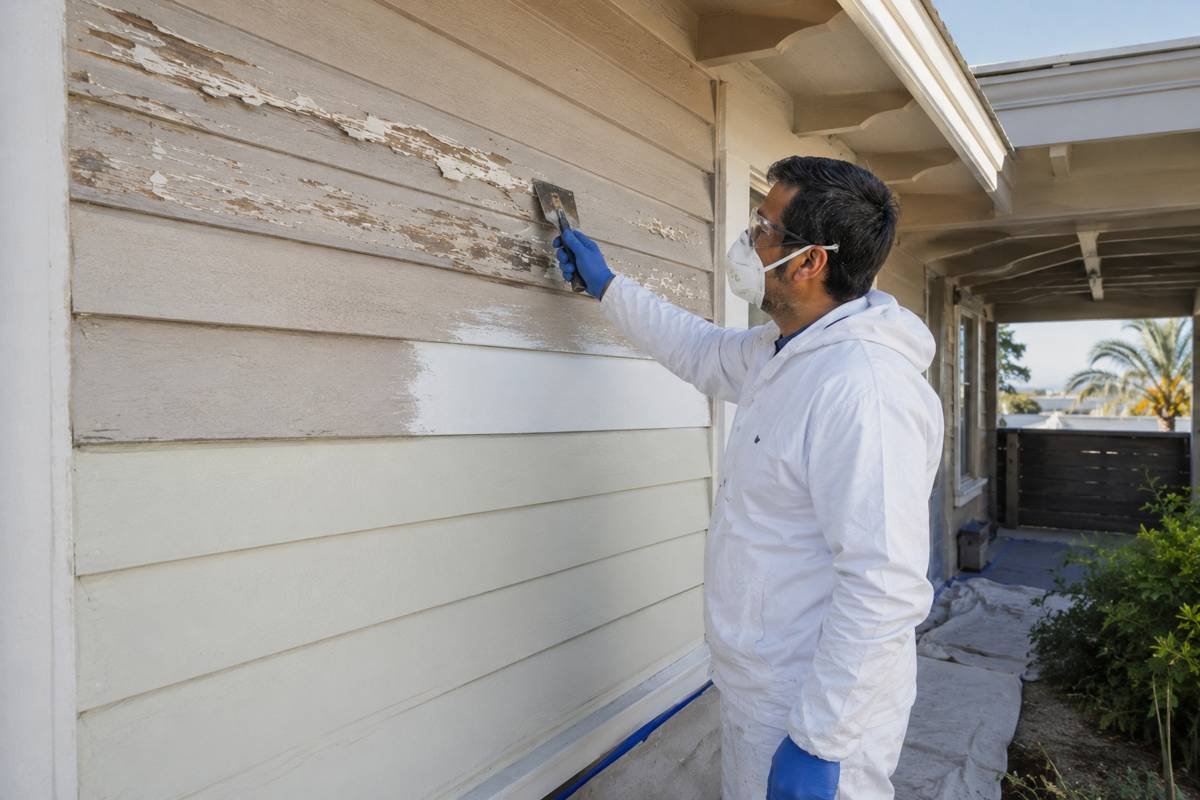
Sand or soda driven at 100-year-old redwood erodes the soft spring growth and leaves a fuzzed surface no coating can level. On original lime stucco it strips the hard troweled skin that carries the wall's weather resistance. We scrape by hand, soften heavy layers with infrared heat, feather rather than strip, and consolidate punky wood with a low-viscosity epoxy.
Paint archaeology and colour matching
A cut through the layers on a 1905 bungalow often shows ten or more schemes. We take samples from protected locations, expose them in a shallow bevel, and read the sequence to find the original body, trim and sash colours. Matching happens under daylight, not shop light, because the marine layer locals call June Gloom shifts how a colour reads for months at a time. Take the historic scheme, a modern reading of it, or a clean departure, with the evidence in hand.
Lead-safe work under the EPA RRP rule
Housing built before 1978 falls under the EPA Renovation, Repair and Painting rule: testing before disturbance, plastic containment and sealed openings, HEPA vacuums and wet scraping instead of dry sanding, daily cleanup, and waste handled properly. Testing first beats guessing, because it decides whether the job needs full containment at all.
05
Where we work and why owners choose us
We restore homes across Ocean Park, Sunset Park, the Pico Neighborhood, Mid-City and North of Montana, covering ZIP codes 90401 through 90405.
Older stock does not stop at the city line. Palos Verdes Estates brings 1920s lime stucco under art jury colour review, Beverly Hills has 1920s and 1930s Spanish and Mediterranean stucco, and Pacific Palisades covers significant homes that need careful colour matching.
Why Santa Monica homeowners choose us
Restoration is a different trade from repainting, and the difference shows up years later. We are fully licensed, insured and bonded, and the same foreman runs the job from survey to closeout, so nobody re-explains which corbels are original. Surface prep is documented before coating.
What shapes the estimate
How much wood needs consolidating rather than coating, elevation height and access, whether lead is present, and whether the property sits in a designated district.
06
Frequently asked questions about restoration painting
Do I need Landmarks Commission approval to repaint my house?
It depends on whether the property is a designated landmark or a contributing building in a district such as the Third Street Neighborhood Historic District. Ordinary maintenance on an undesignated home does not. We check status before writing the scope.
How do you find the original colours?
By cutting and reading a paint stratigraphy sample. Layers are exposed in a shallow bevel and read under daylight and magnification. On a 1903 to 1915 bungalow, eight to twelve stacked schemes is normal.
Is my pre-1978 house automatically lead-contaminated?
No, but it is treated as lead-bearing until testing shows otherwise, as the EPA RRP rule requires. Testing decides whether the job needs full containment.
Can you pressure wash a historic house?
Not at the pressures used on new stucco. High pressure drives water behind siding and erodes soft lime finishes. We use low-pressure rinsing instead.
Will limewash work on my stucco?
Only if the stucco is bare or previously limewashed. Limewash is absorbed rather than adhered, so it will not bond to an acrylic-coated wall without stripping or a mineral primer.
How long does a full exterior restoration take?
Most 1,500 to 2,500 square foot bungalows run three to six weeks, driven by wood repair and lead-safe prep rather than coating time.
Do you replace original windows?
We restore them wherever the wood can be saved. Consolidated and reglazed old-growth sash outlasts most replacements, and on a contributing building replacement can trigger review that restoration avoids.
07
Related painting services and service areas
Homeowners who want one crew across the whole scope start with the survey and work outward from it.
- Limewash & Mineral Coatings
- Venetian Plaster & Specialty Finishes
- Stucco Painting
- Brick & Masonry Painting
- Interior House Painting
- Wallpaper Removal & Repainting
Every painting service we offer.
Service areas
The service areas map lists every city we cover.
Schedule your historic restoration survey
You get a written account of what is original, what is failing and what can be saved, before you commit to anything.
- Free written estimate, element by element
- Lead-safe preparation as standard
- Licensed, insured and bonded